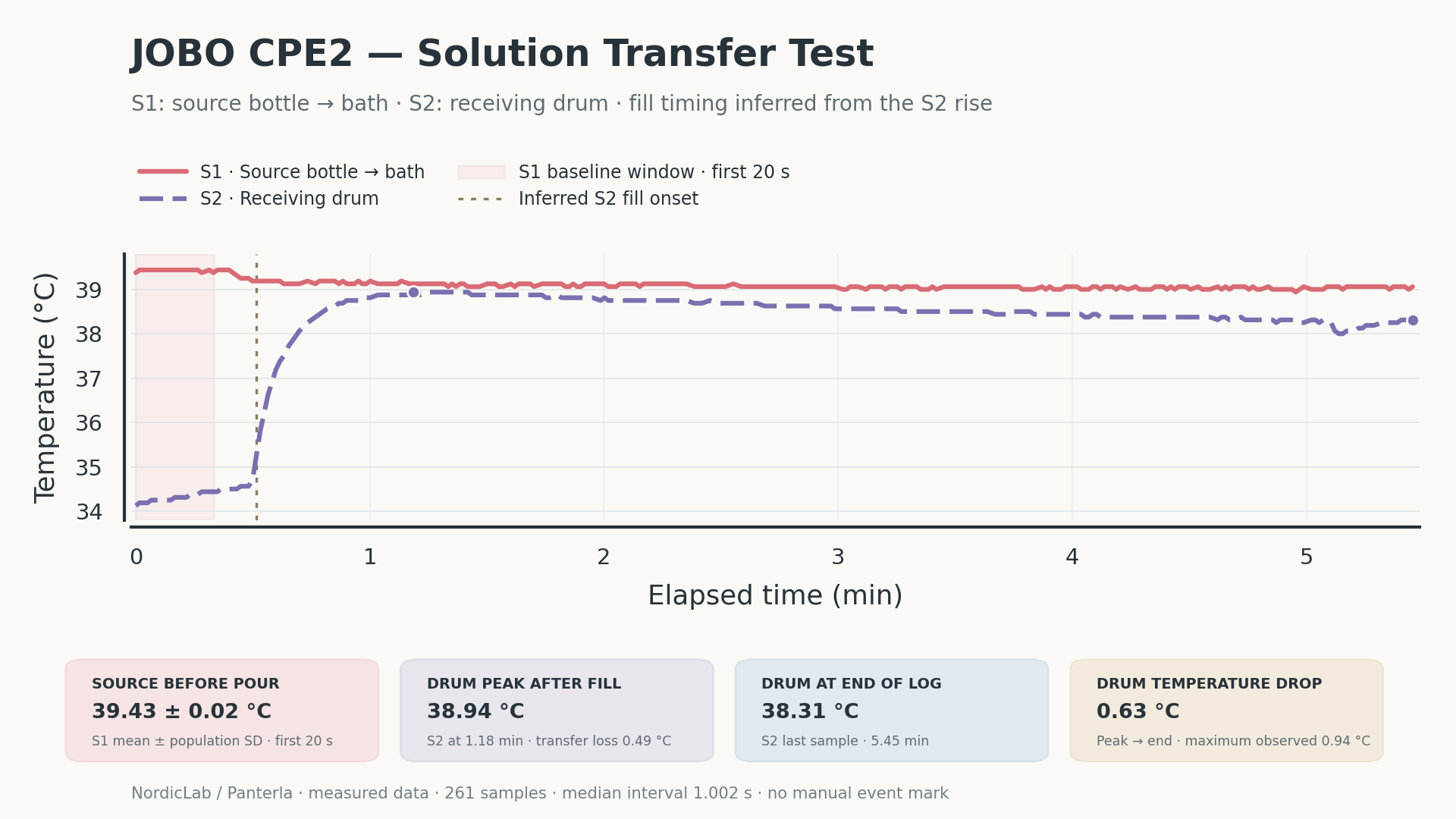
JOBO CPE2 transfer test showing source-bottle readings and the receiving drum rising to 38.94°C then cooling

JOBO CPE2: Warm Bottles, Uneven Readings, and a Cooling Drum

The JOBO CPE2 produced locally steady readings, but different locations did not converge. The transfer test adds the process question: warm liquid entered the rotating drum, then its measured temperature fell. What this means for preheat, circulation, and Panterla’s readiness criteria.

September 25, 2026 · 9 min · NordicLab
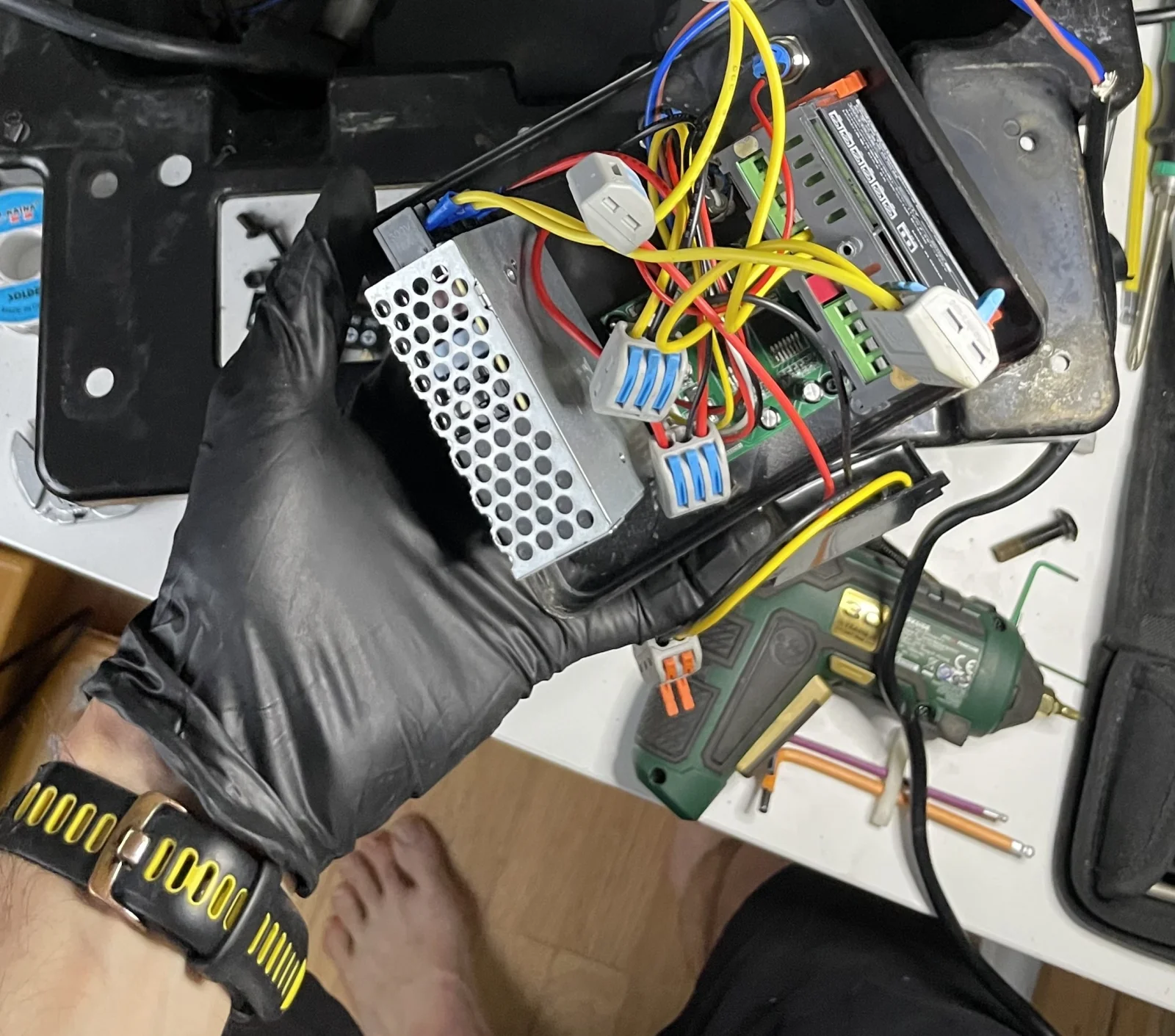
Hand holding the THD Darkroom CP Lift's removed control module, wires and connectors visible, next to the open bath enclosure

THD Lift: Bath Stability, Bottle Lag, and the Opened Machine

The corrected bath-corner readings were locally steady, but the bottle was still warming. The teardown also exposed wet-area wiring problems and identified the installed controller as WH1435A. Small temperature variation does not establish accuracy or electrical safety.

September 21, 2026 · 12 min · NordicLab
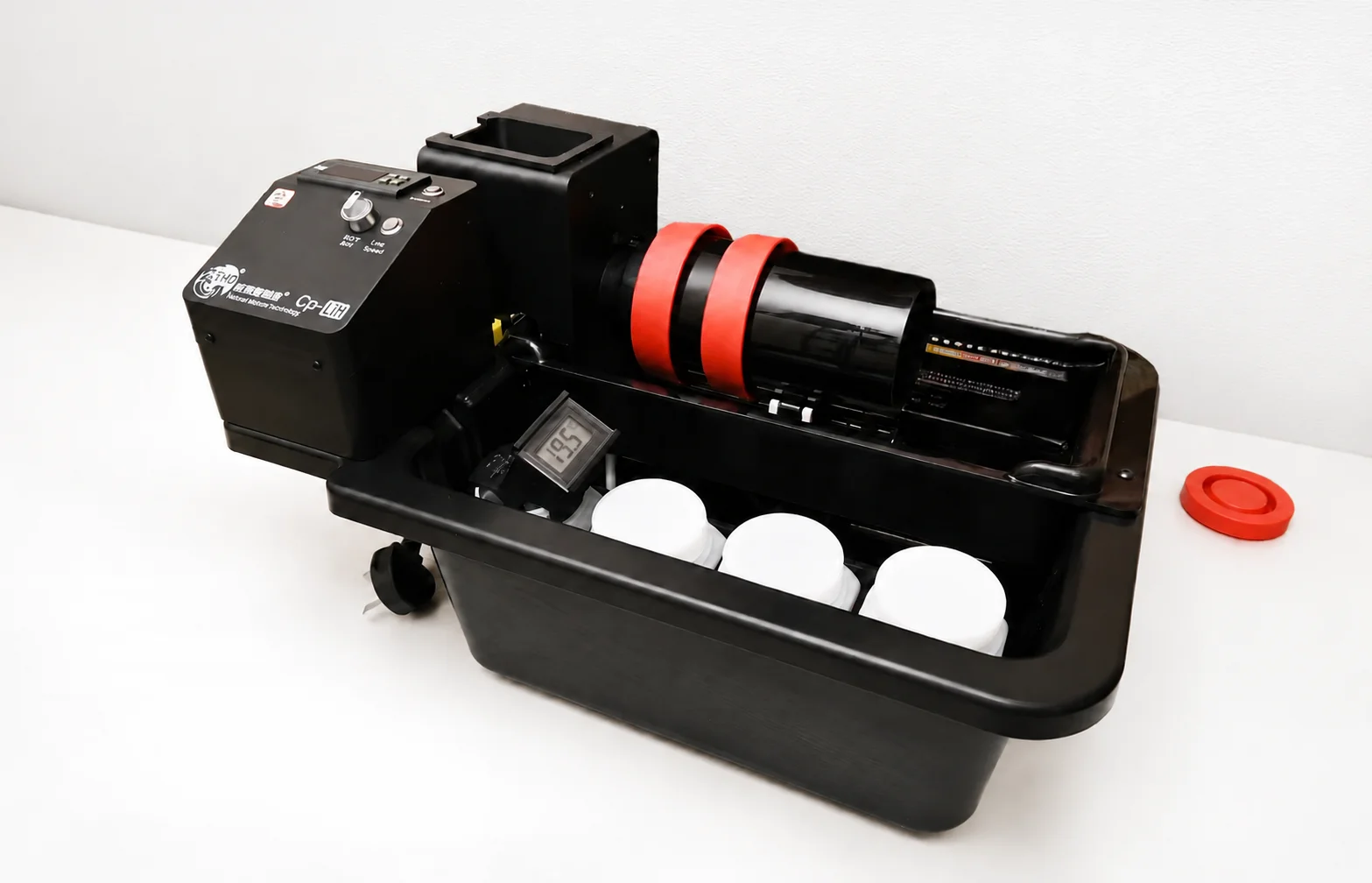
THD Darkroom CP Lift processor on a workbench, showing the control box, water bath, and three processing bottles inside the tank

A Broken THD Lift as a Real-World Test Subject for PanterLA

The pump, heater, and Willhi WH1435A controller operated, but the exposed gear drive failed. Follow-up logging put numbers on the thermal lag: the three-corner mean reached 38°C at 24.3 minutes; the bottle was still below it at 39.3 minutes.

September 19, 2026 · 11 min · NordicLab
Direct heating rate test — linear fit of 24V immersion heater bringing 500ml of water from room temperature to 38°C

Direct Heating Film Chemistry: Why Panterla Is Moving Beyond the Water Bath

A note on the name. “Panterla One” is the working name for this automatic film developing machine — nothing is finalized yet, but it’s the name used for the project going forward in these engineering logs. Summary. I tested direct heating as a replacement for the traditional water bath in the Panterla automatic film development machine. The prototype used a 24 V / 150 W immersion heater, approximately 500 ml of water, active circulation, a digital temperature probe, and closed-loop temperature control. The measured linear heating rate was 3.59°C/min, corresponding to an extrapolated 20→38°C heat-up time of 5.02 minutes. During a separate steady-state test, the recorded temperature had a standard deviation of only 0.033°C over the analyzed four-minute window. The experiment also exposed a separate problem: the control probe and external logger disagreed by about 0.3°C, showing why stability and absolute accuracy must be treated as two different engineering problems. ...
September 6, 2026 · 17 min · NordicLab
Chemicals heating module for automatic film developer — 3D model with fan

Heating Methods for C-41: Which One Wins?

Precise temperature control is one of the hardest engineering problems in an automatic film developing machine. This experiment used 38°C as its reference, but the working temperature and tolerance must come from the selected chemistry’s instructions. For an autonomous machine, I needed to compare how quickly each heating approach brought the liquid toward that reference and how much its recorded temperature varied afterward. I compared five heating approaches in six configurations, including runs with and without active stirring. These are the original results; the later processor experiments linked below add process-container and transfer measurements rather than replacing this dataset. ...

June 30, 2026 · 5 min · NordicLab