A note on the series. This continues the THD Darkroom CP Lift teardown — a used, already-failing semi-automatic film processor being measured and disassembled as a real-world test subject for PanterLA, NordicLab’s open-source automatic film processor.
Summary. Five temperature channels were logged for 8.16 minutes after warm-up and a probe-offset alignment. The three-corner mean was 38.633°C, with a population standard deviation of 0.023°C. The bottle averaged 37.978°C, remained 0.654°C below the corner mean, and continued warming at +0.0188°C/min. Removing the control module then exposed bare corroded wiring and unidentified bath-side components. An independent heater high-limit has not been verified in the inspected circuit. Temperature repeatability, absolute accuracy, and hardware safety remain separate questions.
Revised 1 October 2026 against the raw log, controller-label photographs, and original manuals. The measurement and disassembly were recorded on 19 September.
What this measurement answers
The first log in this series established that the pump, heater, and controller operated. Its later rear-label photograph identifies Willhi WH1435A. The earlier WH1435+ identification referred to related-family documentation and has been corrected. A fixed CA correction cannot track the bottle’s changing thermal lag, regardless of how the installed firmware uses that parameter internally.
This session asks two narrower questions directly, with logged data instead of a single spot check:
- How uniform is the bath itself, once it has stopped actively warming?
- How far behind does a bottle sitting in that bath actually lag, and is that gap closing or growing?
Setup
Five type-K probes were logged together: s1 in a bottle, s2 in the tray under the drum, and s3–s5 at the left rear, right rear, and right front bath corners. The video records the circulation pump running, but pump state and flow were not logged. Before this run, all five probes were placed together in the bottle and their offsets aligned to a reference thermometer reading approximately 37.7°C. This was a practical alignment near one temperature; individual corrections and reference uncertainty were not saved.
The log covers 371 samples over 8.16 minutes. Its median recorded interval is 1.002 s, but the sample-count rate is 0.756 Hz, with 119 skipped sequence values. Statistics weight recorded samples equally, and SD means population standard deviation rather than uncertainty.
The log starts 9 minutes 57.617 seconds after the previous warm-up ended. During that unrecorded interval the probes were brought together, adjusted, and returned to their locations. The decrease from approximately 0.66°C recorded corner spread late in warm-up to 0.062°C here cannot isolate improved circulation or settling: channel corrections, relocation, and operating changes are confounded. The two logs must remain separate.
The bath holds; the bottle doesn’t
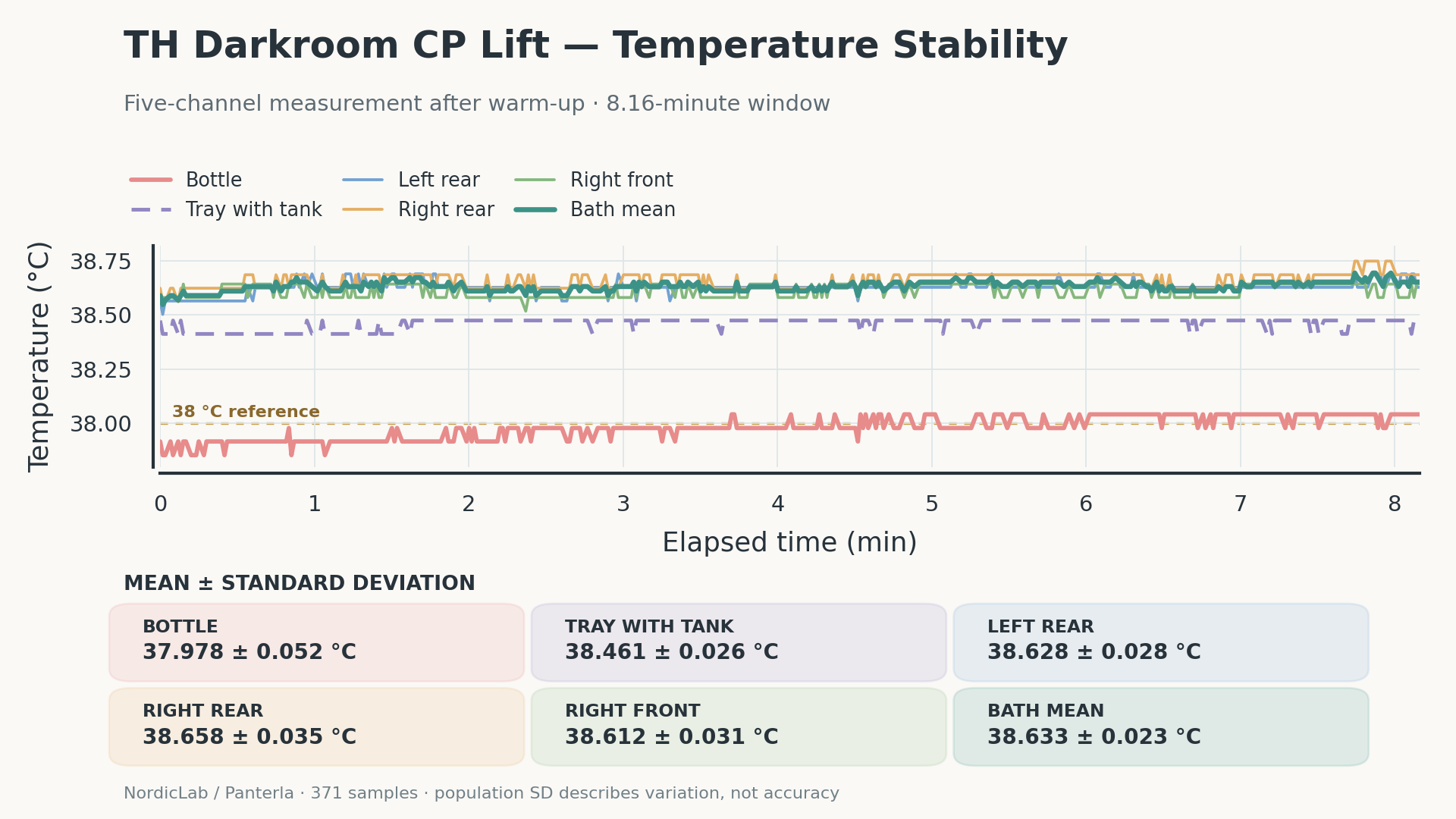 The calculation cards show mean ± population SD. The bath mean is the unweighted mean of three corner probes; it is not a whole-bath mass-average temperature.
| Location | Mean | Min–max | Std. dev. | Linear drift |
|---|---|---|---|---|
| Bottle | 37.978 °C | 37.854–38.042 °C | 0.052 °C | +0.0188 °C/min |
| Tray with tank | 38.461 °C | 38.413–38.475 °C | 0.026 °C | +0.0055 °C/min |
| Left rear corner | 38.628 °C | 38.503–38.690 °C | 0.028 °C | +0.0035 °C/min |
| Right rear corner | 38.658 °C | 38.561–38.749 °C | 0.035 °C | +0.0057 °C/min |
| Right front corner | 38.612 °C | 38.518–38.643 °C | 0.031 °C | +0.0030 °C/min |
| Three-corner bath mean | 38.633 °C | 38.548–38.694 °C | 0.023 °C | +0.0041 °C/min |
The corrected corner readings had a mean instantaneous spread of 0.062°C, with a 0.168°C maximum. The 0.023°C SD belongs to their arithmetic mean over time, not to each corner’s agreement or the instrument’s accuracy. Averaging three quantized channels can produce smaller increments than an individual probe’s approximately 0.06°C output steps.
The fitted change in the corner mean was approximately +0.033°C across the window. This is useful evidence of local short-term steadiness at the measured positions. It does not establish uniformity everywhere in the bath, absolute accuracy, or the controller’s algorithm; heater output was not recorded.
The bottle averaged 37.978°C and continued warming at +0.0188°C/min. Its mean deficit was 0.654°C, decreasing on the fitted trend at approximately 0.0147°C/min. It was catching up, but had not demonstrated equilibrium. The tray/tank probe averaged 0.172°C below the corner mean; this measurement alone does not identify the heat-transfer cause.
The practical result is that crossing the 38°C reference does not establish a settled process container. A bath-only probe cannot directly observe the bottle’s lag.
How long the bottle actually takes
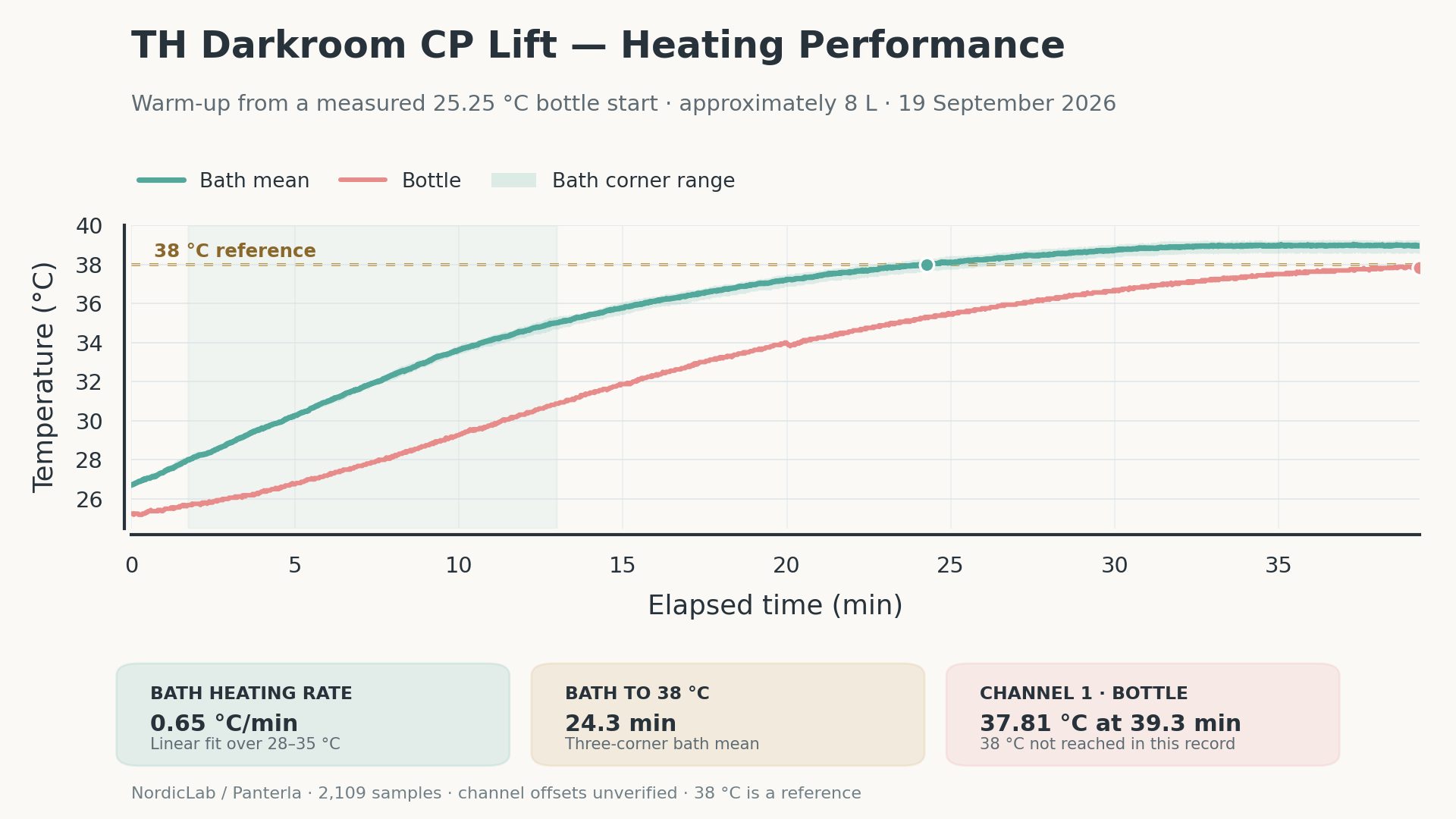 This context figure ends before the probe adjustment and logging gap. It does not join the two experiments into one curve.
The earlier continuous warm-up record provides context. Starting from a measured 25.25°C bottle reading, with room air temperature unlogged:
- the bath mean warmed at 0.65 °C/min and reached 38 °C after 24.3 minutes;
- the bottle (Channel 1) reached 37.812 °C after 39.3 minutes and had not reached 38 °C by the end of the continuous record.
More than 15 minutes after the corner mean crossed 38°C, the bottle still had not crossed it in that continuous record. Its exact crossing time cannot be reconstructed through the subsequent unlogged interval and offset adjustment. The video’s roughly 25-minute bath and 40-minute bottle estimates are useful context, rather than substitute event times.
Opening the bath enclosure
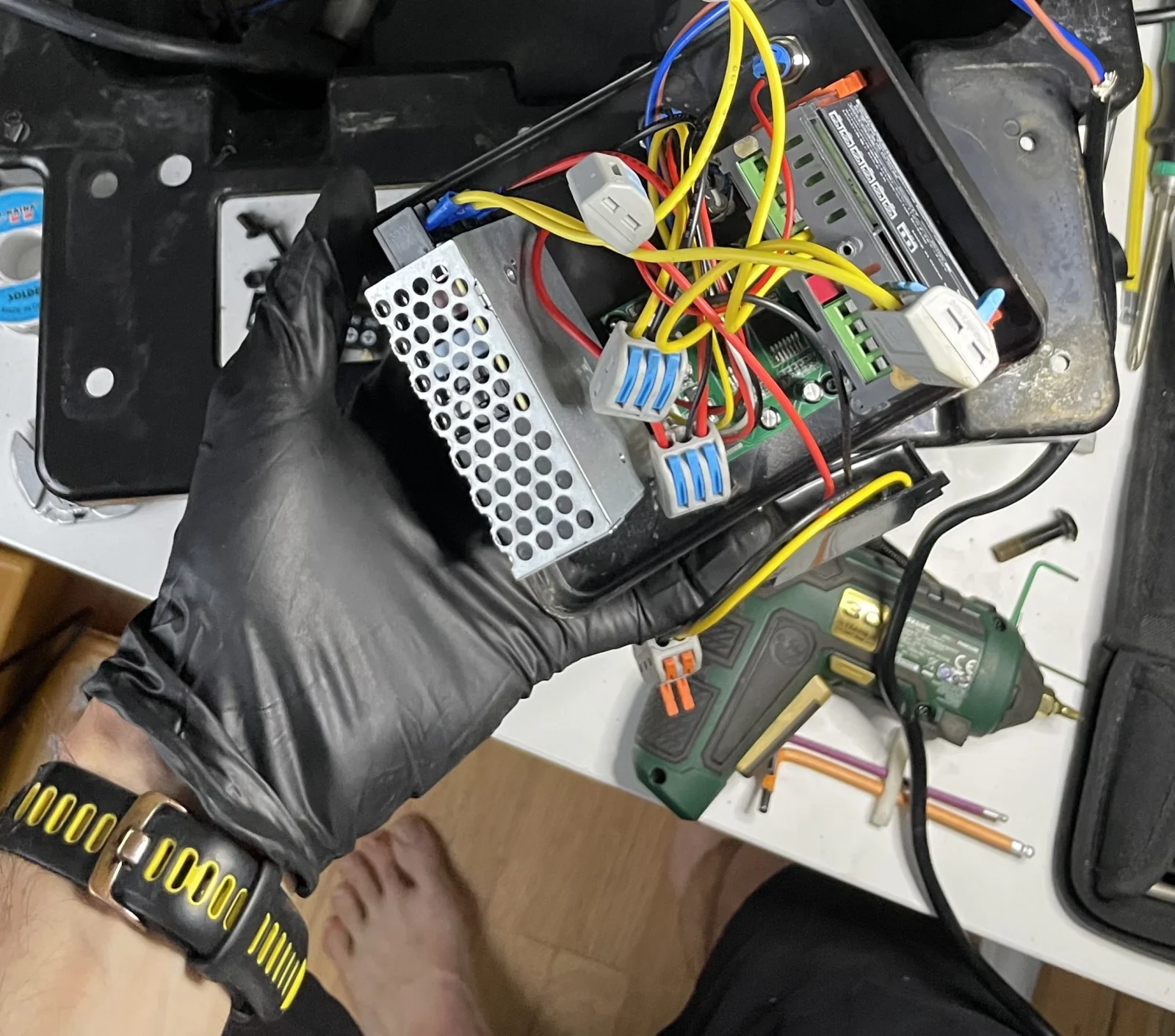
The same session continued past the measurement: the control module was unbolted and lifted out of the bath enclosure, exposing the wet section for the first time in this series.
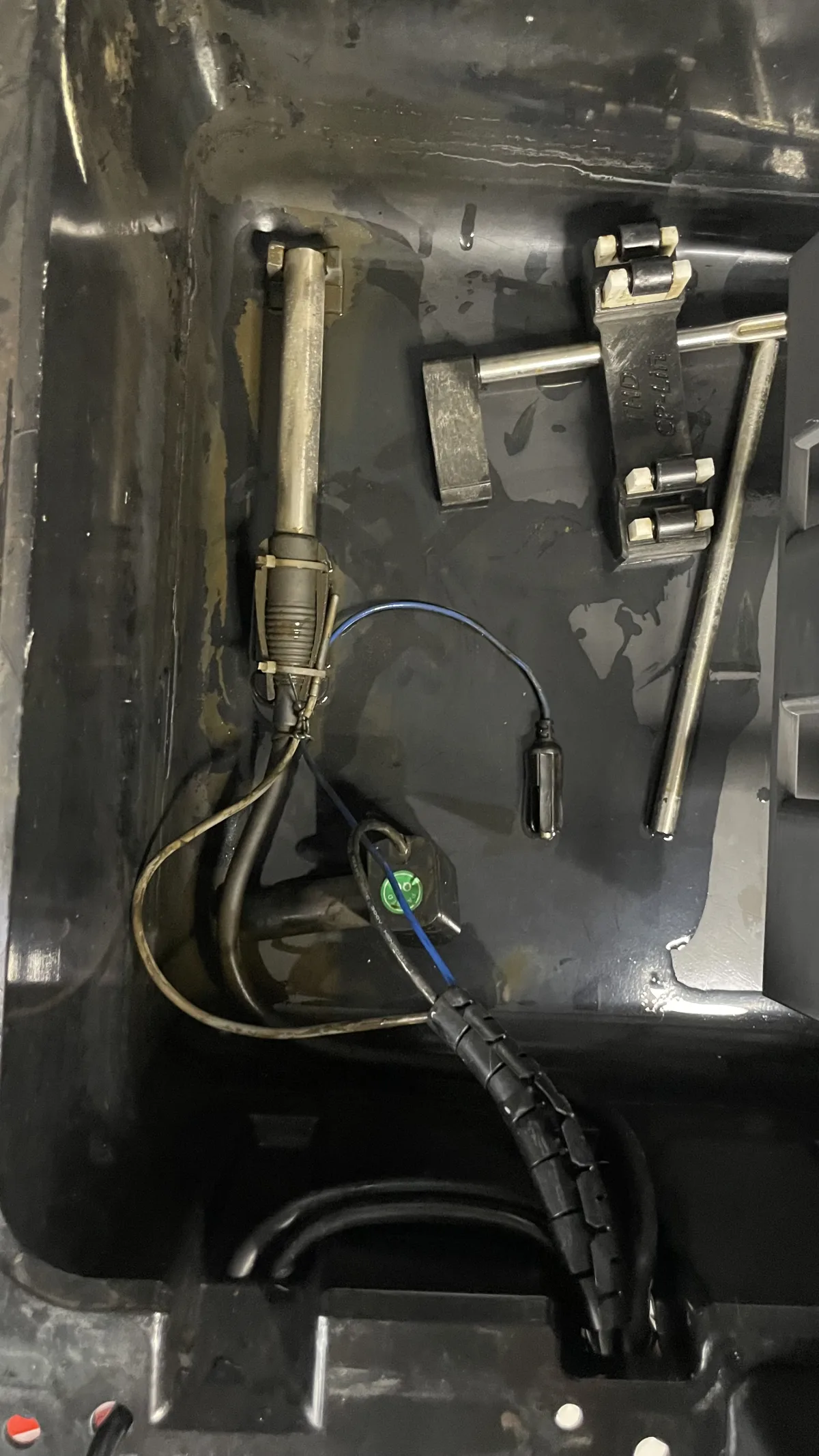 The immersion heater runs along the left side of the bath. The small encapsulated device on the blue lead is probably the bath-temperature probe; the compact assembly with the green inspection sticker is probably the circulation pump.
Both functional assignments are visual and await continuity tracing to the WH1435A circuit. Neither has a readable rating. The automatic transcript renders the heater description as “220 W”; the machine manual lists 800 W for the processor, and the warm-up calculation gives a conditional 317–363 W water heat-storage rate for 7–8 kg. These are different kinds of evidence. The inconsistency requires checking the audio, actual water mass, other heat inputs, and isolated element resistance; none is an accepted heater rating.
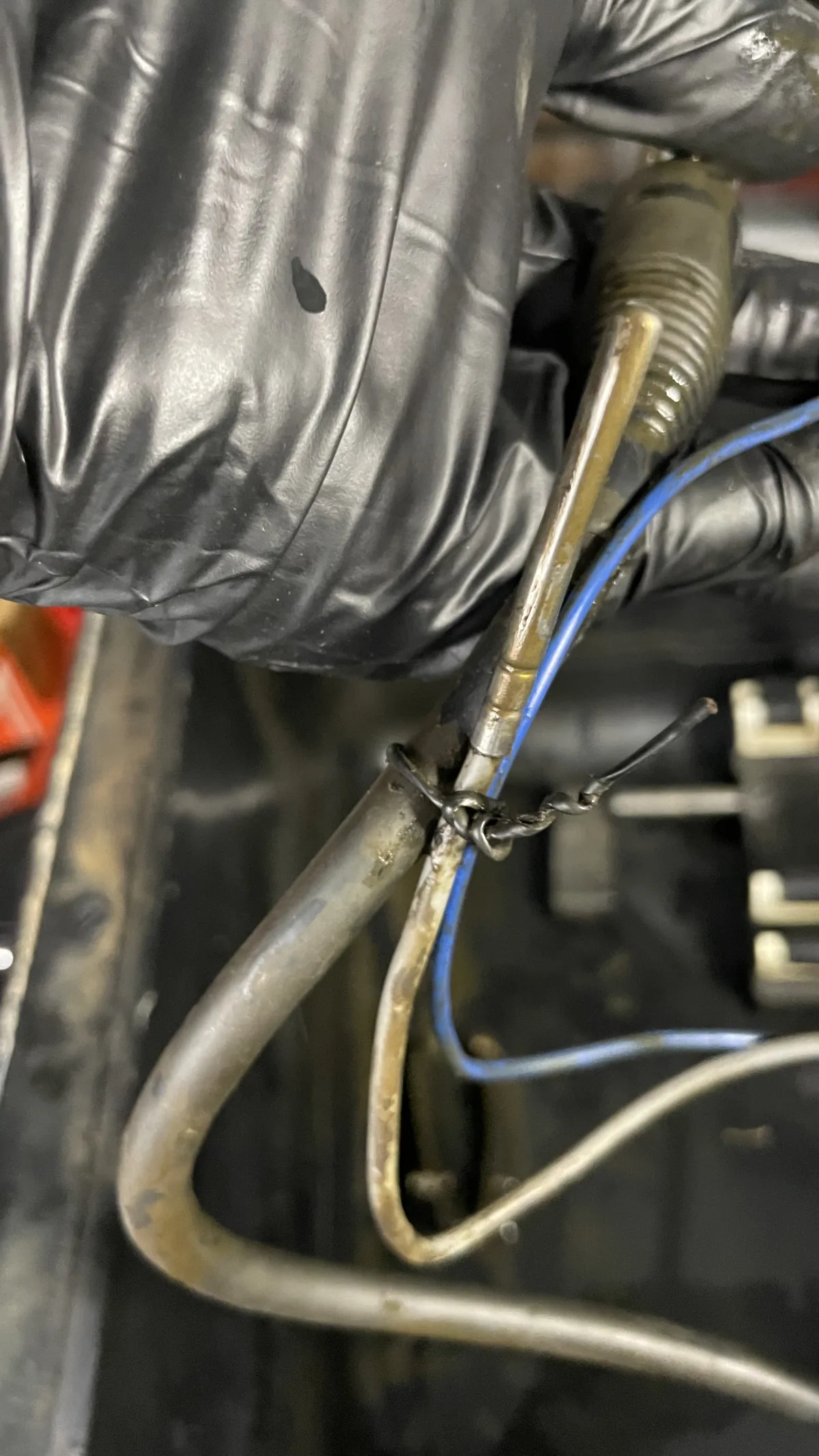 Bare twisted and soldered joints, damaged insulation, and visible oxidation sit right next to the heater in the wet section — not suitable for reassembly as found.
The photographed joints are unsuitable for reassembly as found. They need sealed terminations, strain relief, verified conductor assignment, and protection appropriate to the actual circuit. This is direct evidence for a serviceable wet/dry boundary in Panterla, not evidence that functioning wiring is safe wiring.
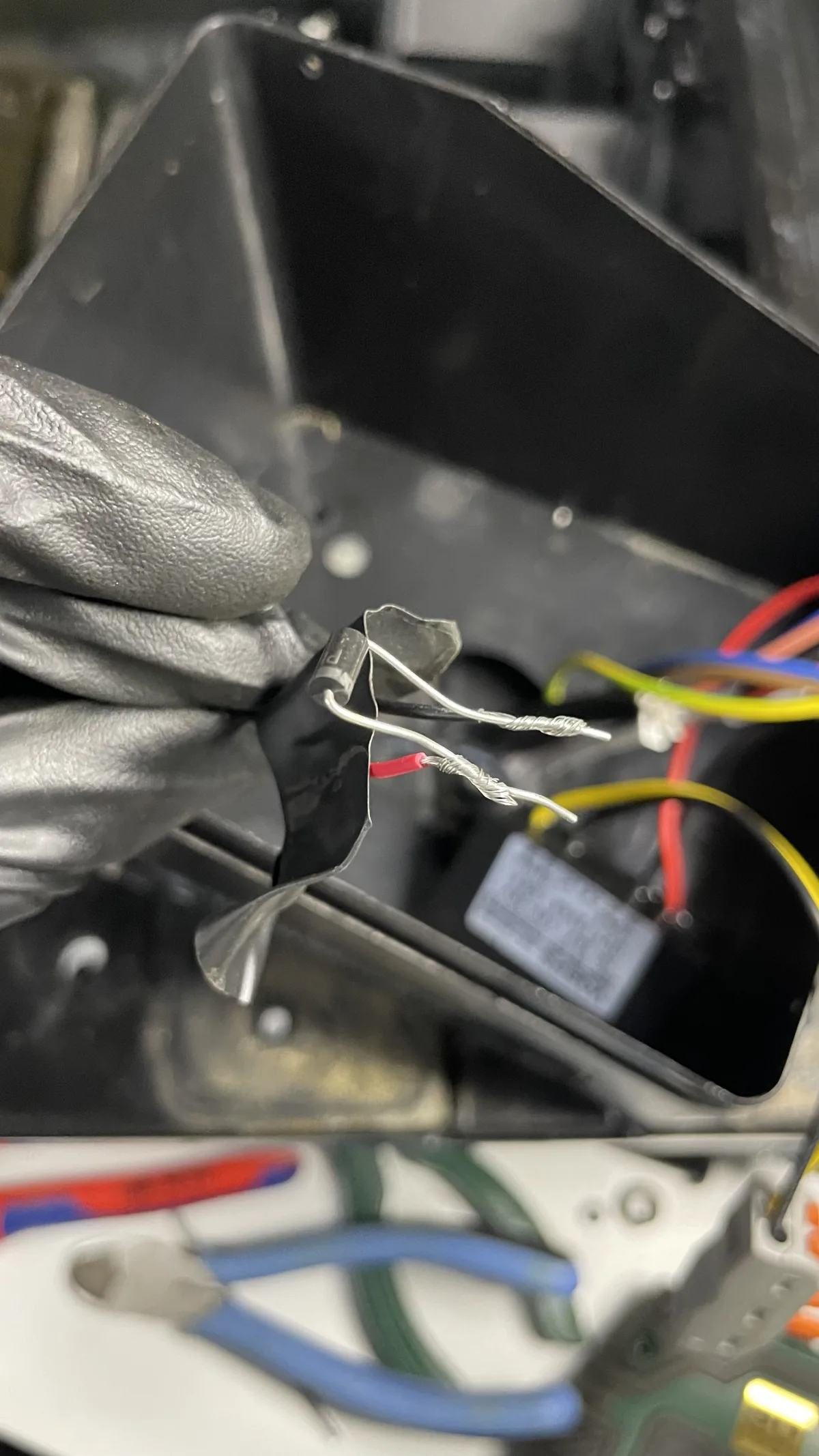 An unidentified axial component in a taped splice — probably a diode, but its marking and circuit role aren’t readable yet.
One splice contains a component that looks like a diode but can’t be identified from the photograph alone. Its role — protection, rectification, something else — is still an open question pending cleaning, macro photography, and a continuity/diode-mode check.
What’s confirmed so far
| ID | Assembly | Status |
|---|---|---|
| BH-01 | Tubular immersion heater | Function visually confirmed; rating and model unknown |
| BH-02 | Encapsulated bath-temperature probe | Probable function; sensor type unconfirmed |
| BH-03 | Bath circulation pump and hose | Probable function; model, voltage, flow, and head unknown |
| BH-04 | Axial component in taped splice | Component visible; identity and function unresolved |
| BH-06 | Drum support rods and roller assembly | Mechanical function confirmed visually |
| BH-07 | Bottle compartments and bath partitions | Mechanical function confirmed visually |
| BH-08 | Lift central chemistry tube | Owner-confirmed fluid path; measured 11 mm OD and 9 mm ID |
The tube dimensions were added to the design record on 22 September, after this temperature measurement. They imply a nominal 1 mm wall and approximately 63.6 mm² internal area. Material, tolerance, sealing, retained liquid, and actual drain rate still require testing.
What the control-module photographs identify
The opened dry enclosure contains a Willhi WH1435A, a Mean Well supply with its exact model unreadable, a VGES S2-T241204 converter marked 24 V input and 12 V / 4 A output, and a motor-driver board with two BTN8984 packages. The power-stage layout supports a brushed-DC H-bridge interpretation; it does not establish the board’s continuous-current rating.
The Mean Well output and the complete power path remain untraced. Its protective-earth terminal appears unconnected in one photograph, but the images do not establish the machine’s complete bonding path. Earth continuity and insulation need measurement before energizing the opened module. Wire colors and IC headline ratings are insufficient substitutes for a wiring map.
Conclusions
The corrected bath-corner readings were locally steady during this short window, while the bottle was still warming. This supports separate readiness criteria for the bath and the process container. It does not settle whether the thermal control loop needs redesign: a longer, uninterrupted, repeated test with unchanged corrections and logged heater output is needed.
The JOBO CPE2 transfer experiment extends this question to a rotating drum: liquid can be warm in the bottle and still produce a falling temperature trace after transfer. Its data are from a different machine and geometry, so they are not combined with this record.
The mechanical findings also motivate the replacement drum-drive study: move the actuator to the dry side, preserve independent drum supports, and confirm movement at the actual drum.
Safety concerns
Good bath stability doesn’t say anything about whether the machine is safe to leave running. Two findings from this session are worth calling out on their own, separate from the temperature data above.
An independent overtemperature cutoff has not been identified and verified in the inspected heater circuit. The full wiring trace is unfinished, so the photographs alone cannot prove that no hidden protective component exists. The original CP-lift manual’s RCD description does not document a separate thermal high-limit or low-water cutoff. Panterla’s rebuilt heating system therefore requires independent shutdown that remains effective if normal control or switching fails.
Protection must be checked for the exact model. The original JOBO CPE-2 Plus instructions (©1997; the project’s 2013 archived PDF), page 51, list the thermal overload among Plus-version additions. It cannot be assumed for an original CPE2 or this CP Lift. The JOBO experiment provides the document context and applicability limits.
The wiring and construction quality is inconsistent throughout, not just at one joint. Beyond the bare, corroded splice already shown above, disassembly kept turning up similarly rough points — in the electronics, in how components are mounted, and in general assembly — spread across the machine rather than concentrated in one spot. None of it is necessarily unsafe in isolation, but taken together it’s a pattern, not a one-off.
Neither finding is a reason to panic about a unit already in someone’s darkroom, but both are reasons not to leave this specific machine heating unattended until they’re addressed, and both go straight to the top of the rebuild list — a thermal cutoff independent of the main controller is now a hard requirement for PanterLA, not a nice-to-have.
Requirements this adds to PanterLA
This sharpens, rather than replaces, the requirements list from the first assessment:
- Verify and provide independent heater shutdown, including overtemperature and loss of safe immersion. Complete the wiring trace and protective-device checks rather than inferring protection from the controller or RCD.
- Don’t treat bath temperature as process temperature. A bath-only setpoint, however stable, is not sufficient evidence that chemistry in a bottle or drum has reached temperature — confirmed here with logged data, not just an estimate.
- Define an explicit process-ready condition (e.g., a modeled or measured chemistry temperature within a tolerance band) rather than triggering on bath setpoint reached.
- Route all bath-side wiring through sealed, strain-relieved terminations — the joints found here are a direct example of what not to reproduce.
- Identify every bath-side component electrically before reuse — visual identification (heater, probe, pump) is a starting hypothesis, not a spec.
These sit alongside the existing list from the first log: JOBO-drum compatibility, a protected drive module, corrosion-resistant fasteners, accessible wiring, and full documentation of every part, published as it’s learned.
Next experiment
- Run a single uninterrupted test from cold start through at least 30 minutes past the point the bottle reaches its process reference.
- Log controller setpoint, controller process value, heater state, pump state, room temperature, and exact water mass alongside all five channels.
- Repeat the same configuration at least three times to check repeatability of bath stability, bottle lag, and bath-to-bottle offset.
- Trace the bath probe to the WH1435A sensor terminals and measure its resistance at known temperatures.
- Measure heater resistance, insulation resistance, and operating current directly.
- Identify and test the unidentified axial component.
- Produce a numbered wiring map before the machine is reassembled or re-energized.
Evidence and limitations
- The stability record is 8.16 minutes long and may not contain a complete long-period heater cycle.
- Controller setpoint, displayed process value, heater power, pump state, flow, and room temperature were not logged in this session.
- Exact water mass was not recorded.
- Probe alignment was a practical zero, not a traceable calibration; individual correction values weren’t logged.
- The offset adjustment and 597.617-second gap prevent attributing the change in corner spread to circulation or settling alone.
- Only one stability run exists, so repeatability is unknown.
- Water in a stationary bottle is a proxy for photographic chemistry in a rotating drum — rotation and internal liquid motion change heat transfer and were not part of this test.
- This report is based on the logged CSV data, the linked video, and its automatic English captions, which contain recognition errors; unclear spoken details were not promoted into firm conclusions.
Sources and reproducibility
The temperature data and verification bundle contains this raw log, the separate warm-up and JOBO records, saved summaries, and a Python standard-library verifier. The 1 October review reproduced 189 metrics across six CSV files with zero mismatches. That checks the calculations, not sensor accuracy.
The original CP-lift Instruction Manual, PDF pages 2, 11, and 14, provides machine claims and preheat guidance. The Chinese WH1435+ family manual, PDF pages 2–3, describes PID and additive correction; NordicLab’s English translation is secondary documentation. Neither identifies the installed WH1435A firmware. The temperature-only log cannot prove or disprove PID control.
Support the project
This THD Lift teardown-and-rebuild is being run as an open-source track within PanterLA, funded by the NordicLab community — parts, tools, and the time to make it a proper priority.
The machine itself costs roughly 300 € bought directly in China — cheap for a DIY-friendly processor, and part of why it’s a reasonable subject to cut open and rebuild. The same unit runs closer to 1,000 € landed in Europe, which is a very different proposition once you’re also looking at a plastic enclosure, no overheat protection, and wiring like what’s shown above. That gap is worth sitting with before assuming a unit like this is ready to run unattended out of the box.
The Ko-fi goal for this machine’s repair and upgrade is now funded at 100%, thanks to the NordicLab community. That funding kicks off the next stage properly: putting together a full components list and running the rebuild in the open, sharing every step. Anything raised beyond the goal goes straight into better and more expensive components — including custom parts ordered from professional printers or machined from metal, rather than reused originals.
If you’d like to keep supporting this track going forward, you can do so on Ko-fi.
Follow the rest of the series on YouTube and Instagram.
See you under the safe light.