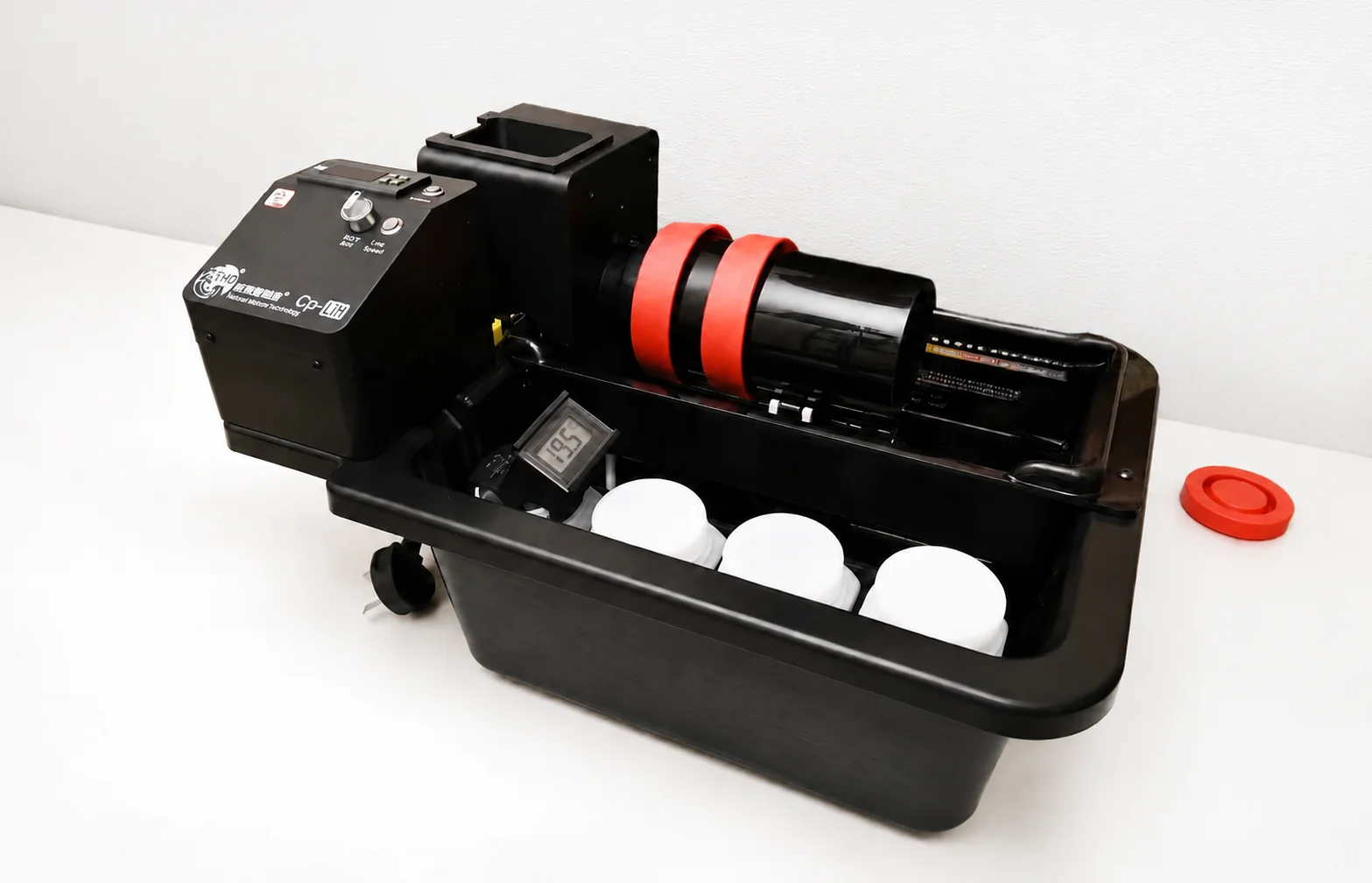
A note on the series. This is the first log in a new track: taking a used, already-failing THD Darkroom CP Lift as a real-world test subject, documenting exactly what still works and what doesn’t, and feeding those findings into PanterLA, NordicLab’s open-source automatic film processor. The whole repair-and-upgrade process — measurements, failures, CAD files, and replacement parts — will be published as it happens.
Summary. A used THD Darkroom CP Lift — a compact semi-automatic rotary processor built around JOBO-style drums — was filled with about 8 L of water and put through a baseline mechanical inspection. The pump, heater, and Willhi WH1435A controller operated at least partially; the drum drive did not, with a corroded or stripped gear train stopping motion from reaching the drum despite the motor still turning. Follow-up logging showed that the three-corner temperature mean reached 38°C after 24.3 minutes, while a stationary water-filled bottle remained below that reference throughout the 39.3-minute warm-up record.
Updated 1 October 2026 after checking the controller photograph, original manuals, and raw temperature logs. The recorded inspection was on 18 September; the five-channel warm-up was logged on 19 September.
Why a broken machine, not a clean prototype
PanterLA needs a physical machine that can be measured, opened up, and changed without starting from an expensive new platform. A used, already-faulty processor is more useful for this than a healthy one — its damage points directly at the parts that don’t survive real lab use.
The THD Lift also uses the established JOBO-style drum ecosystem, and that’s a deliberate thing to keep. Building a new chemically resistant, light-tight drum system from scratch — and funding the injection molds for it — would consume a large part of this project while duplicating something that already works well and is already widely available, new, used, or compatible. Supporting that existing drum interface means development time goes into motion, temperature, timing, handling, and automation instead.
What is a THD Lift
The THD Darkroom CP Lift is a compact semi-automatic film processor from a Chinese manufacturer: a heated water bath, a circulation pump, motorized drum rotation, and a digital temperature controller, built around JOBO-compatible processing drums. It automates a lot of the repetitive part of film development — mixing and pouring chemistry is still manual, but temperature and agitation are handled by the machine.
It’s a relatively affordable alternative to older JOBO CPE-style processors, but — somewhat surprisingly — very few people in the community actually seem to run one, which is part of why it’s worth documenting properly here.
Don’t reinvent the drum
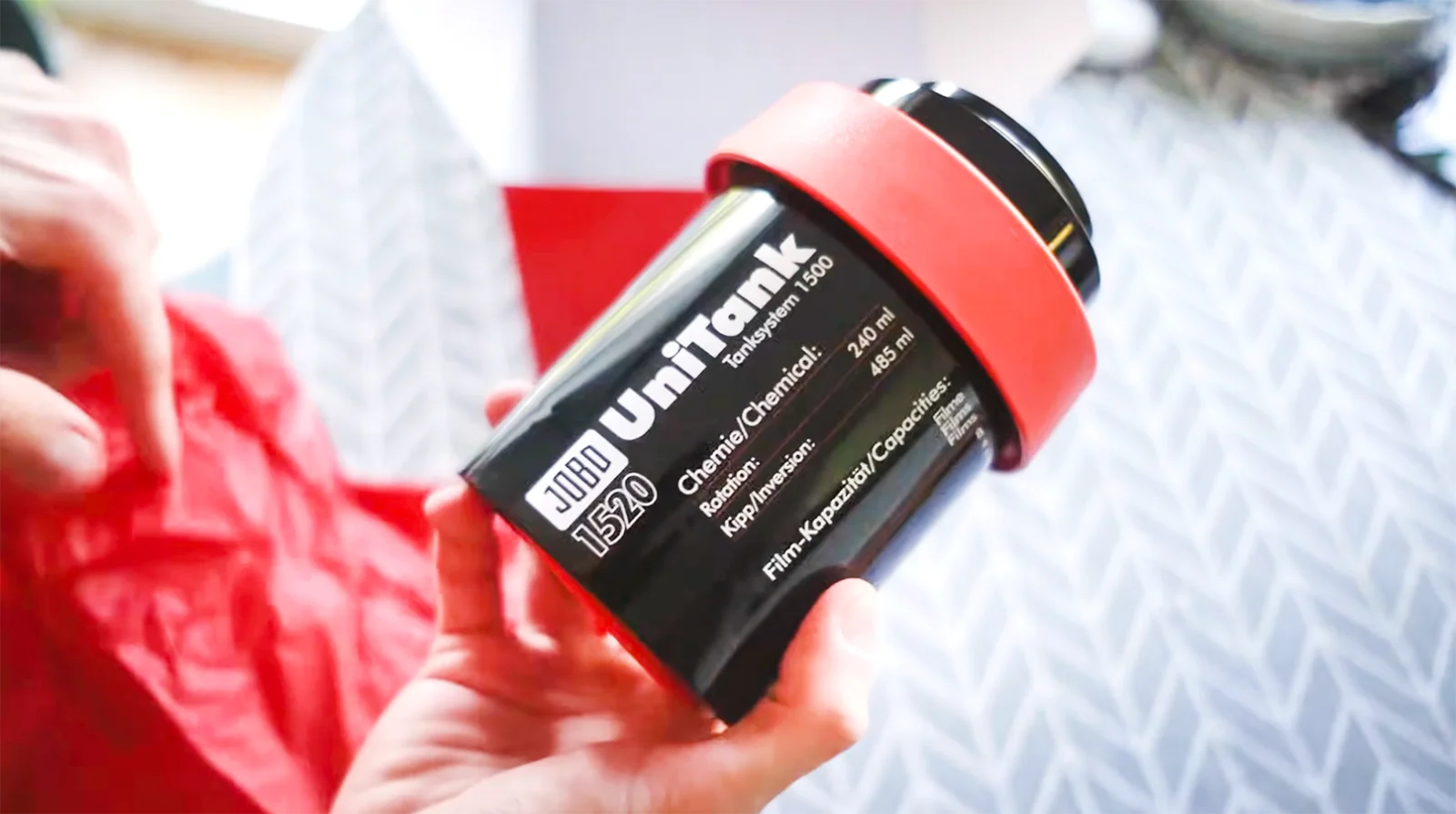 JOBO-compatible drums already solve chemical resistance, light-tightness, reel handling, and sealing across multiple film formats — no reason to design a new one from scratch.
JOBO-compatible drums already exist in new, used, and third-party-compatible versions, and they already solve a genuinely hard set of problems: chemical resistance, light-tightness, reel handling, sealing, and support across film formats. Designing a new drum from scratch would mean molds, materials, and manufacturing — a whole separate project duplicating something that already works. So instead of creating another drum, PanterLA is being built around this existing, proven interface.
Inspection procedure
- Inspect the processor externally and identify its major subsystems: bath, circulation pump, heater, controller, drum drive, lift, bottle area, and control switches.
- Check the fit of a JOBO-style processing drum and an original JOBO bottle.
- Examine the drum clamp and rotation mechanism by hand.
- Fill the bath with approximately 8 L of water.
- Power the processor and test circulation, heating, controller response, and rotation.
- Observe the failed drive at close range to determine whether the motor or the gearbox is responsible.
- Record the working subsystems, the failures, the open questions, and the next disassembly tasks.
The installed controller is WH1435A
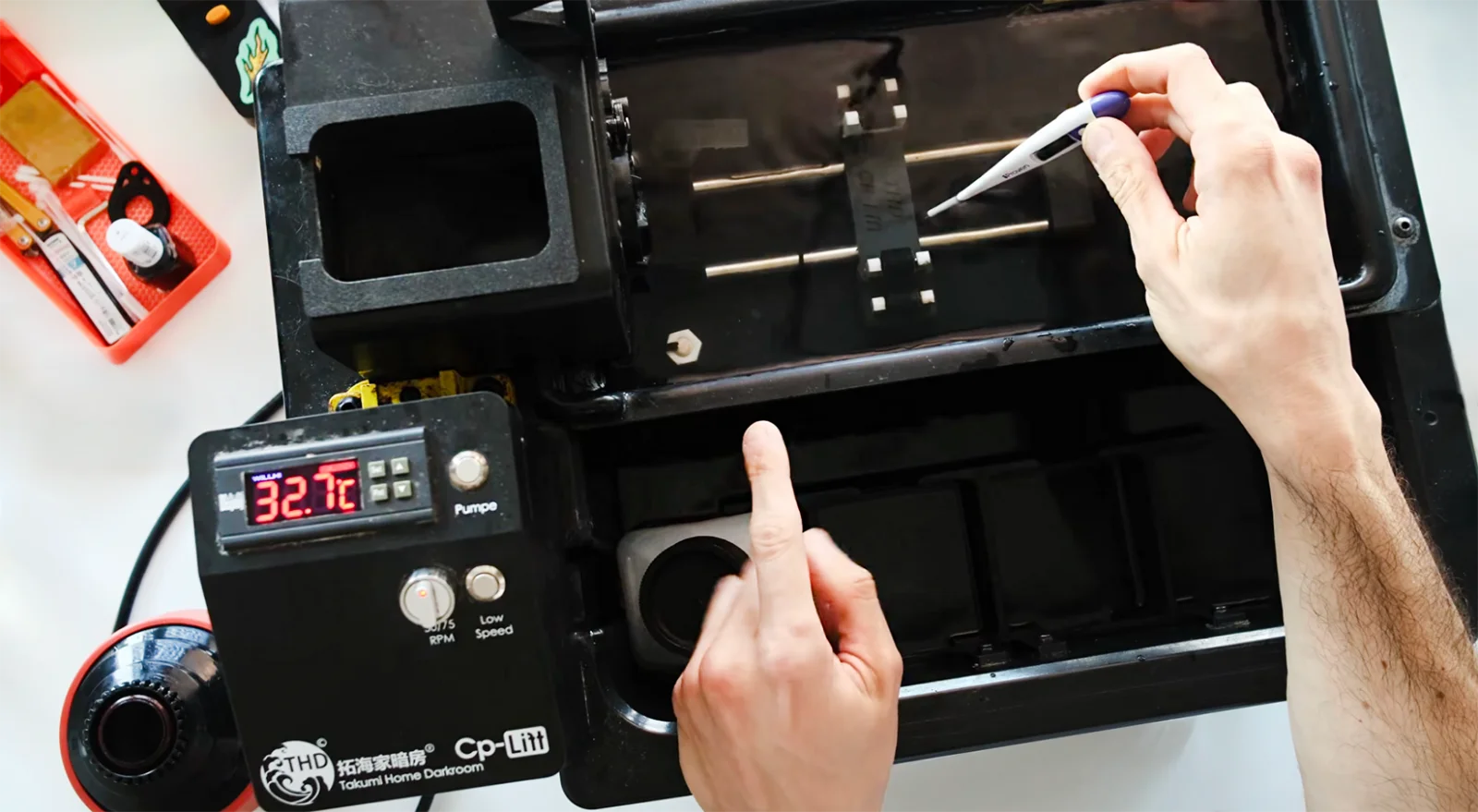 The front panel does not identify the exact controller variant. Its rear label, photographed during disassembly, reads WH1435A.
The photographed rear label identifies a Willhi WH1435A, marked for AC 220 V, an NTC 10 kΩ sensor with B=3435, and a maximum 5 A load. Those are label markings, not measured circuit ratings. The exact terminal use and installed wiring still need continuity tracing.
NordicLab’s English translation of the WH1435+ manual
is useful related-family documentation. It is not an exact manual for the photographed A variant. The original Chinese family manual describes PID control and an additive CA correction on PDF pages 2–3; the installed firmware and variant-specific output behavior remain unverified.
During the session, the bath and a water-filled bottle warmed toward 38°C. The bottle contents were mixed and checked with an external thermometer. The comparison was described as approximately 0.1°C high, and the CA setting was adjusted. The initial and final correction values, thermometer uncertainty, and probe geometry were not recorded.
That was an operating compensation, not a calibration of the bath probe. Calibration requires the compared sensors to be at the same physical temperature. Matching a bath reading to a bottle can hide the real bath-to-bottle difference for one operating condition. This test also does not establish whether CA affects only the display or the controller’s internal decision. Either way, a fixed correction cannot track a changing bottle-temperature lag.
What was found, subsystem by subsystem
| Subsystem | Observation | Status | What it means for PanterLA |
|---|---|---|---|
| Bath and enclosure | Compact enough for a workbench; needed about 8 L of water. | Usable | Record exact operating volume in a controlled test. |
| Circulation pump | Moved water from the lower section to the upper bath; audible. | Working | Inspect, identify manufacturer/rating, measure flow before deciding whether to reuse. |
| Heater | Bath temperature rose reliably after power-up. | Working | Characterize heat-up rate, overshoot, uniformity, and recovery separately. |
| Willhi WH1435A controller | Display and settings responded; CA correction menu accessible. | Working | Verify the exact variant and circuit; use WH1435+ documentation only as a family reference. |
| Drive motor | Produced motion, but that motion didn’t reliably reach the drum. | Partially working | Don’t replace just the motor until the complete drive train has been inspected. |
| Gearbox and gears | Main gear skipped; gearbox appeared corroded or stripped. | Failed | Design a protected, replaceable drive module instead of installing another identical exposed gearbox. |
| Drum clamp | Sticky engagement and removal; a loose unidentified part seemed to be interfering. | Faulty / uncertain | Disassemble, document every part, and establish the intended geometry before redesigning. |
| Lift assembly | Worked from one side; exposed mechanical parts sit close to water. | Not fully tested | Simplify where possible; use corrosion-resistant materials and fasteners. |
| Bottle holder | An original JOBO bottle fit in one position but not correctly in the side positions. | Compatibility problem | Redesign as a replaceable part, tested against a defined bottle list. |
| Mains lead and RCD | Cable was around 1 m; an inline leakage-protection device was present but untested. | Unverified | Provide a practical cable length; verify earth continuity, insulation, and leakage protection before routine use. |
| 3D-printed parts | Several parts are already printed rather than molded. | Promising | Recreate the weak ones, publish editable models, and pick materials for heat/water/chemical exposure. |
Five-channel warm-up: the bottle is the slower part
Two logger files form a continuous 39.3-minute record with 2,109 samples. S1 was in the bottle, S2 in the tray/tank area, and S3–S5 at three bath corners. The “bath mean” below is the unweighted arithmetic mean of those three corners; it is not a measured mass-average temperature of the whole bath.
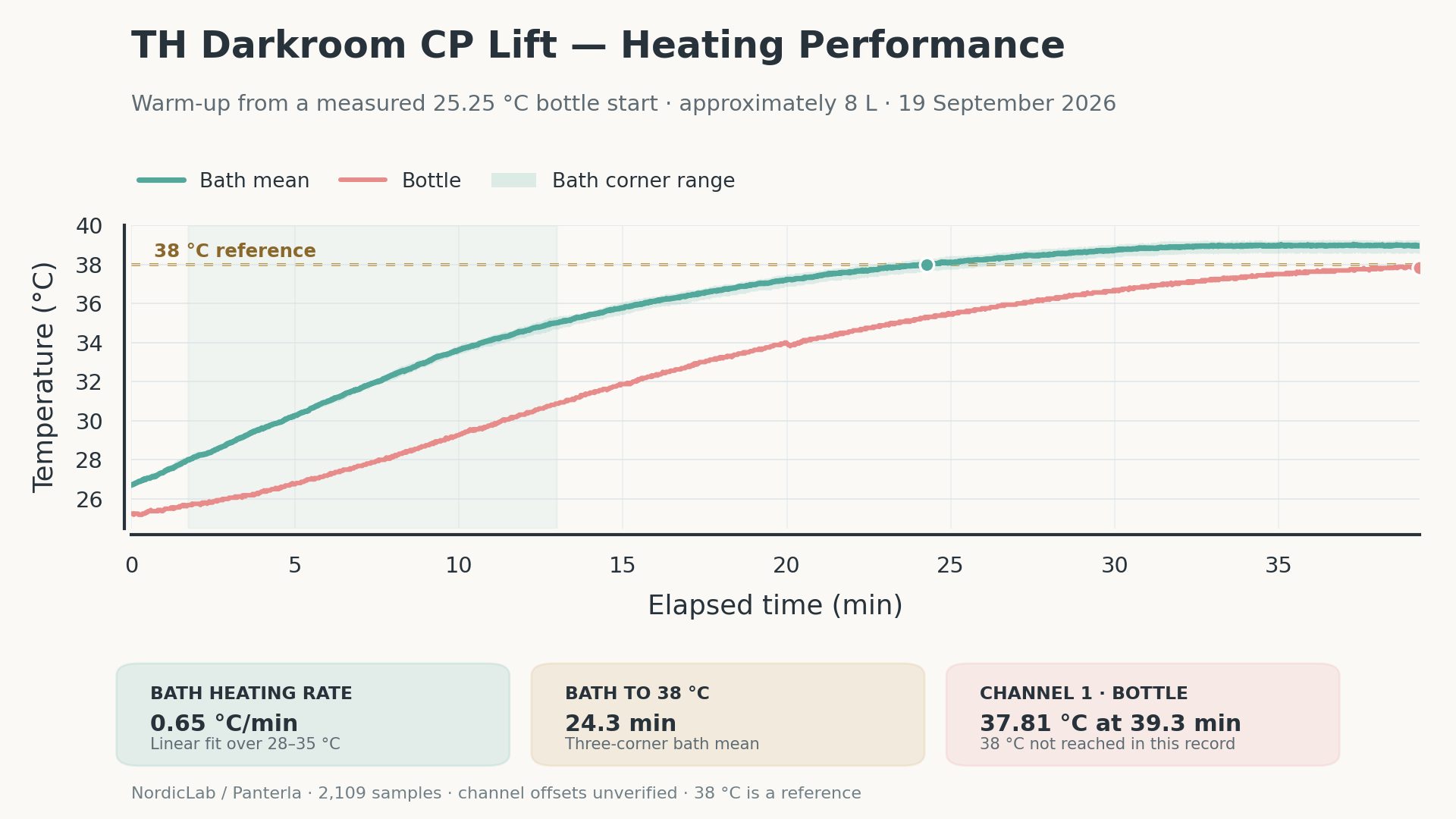 The graph ends with the continuous warm-up record. The 38°C line is a process reference; controller setpoint and heater duty were not recorded in the CSV.
| Location | Start | Final two-minute mean | First recorded ≥38°C |
|---|---|---|---|
| S1 — Bottle | 25.250°C | 37.800°C | Not reached |
| S2 — Tray with tank | 26.438°C | 39.185°C | 23.28 min |
| S3 — Left rear corner | 26.688°C | 39.078°C | 23.39 min |
| S4 — Right rear corner | 26.875°C | 39.239°C | 22.22 min |
| S5 — Right front corner | 26.562°C | 38.577°C | 26.35 min |
| Three-corner mean | 26.708°C | 38.965°C | 24.28 min |
The corner mean rose at 0.650°C/min over 28–35°C. The bottle ended at 37.812°C, still below the reference. During the final two minutes it averaged 1.16°C below the corner mean. The controller display reaching its target would therefore not be sufficient evidence that the bottle was ready.
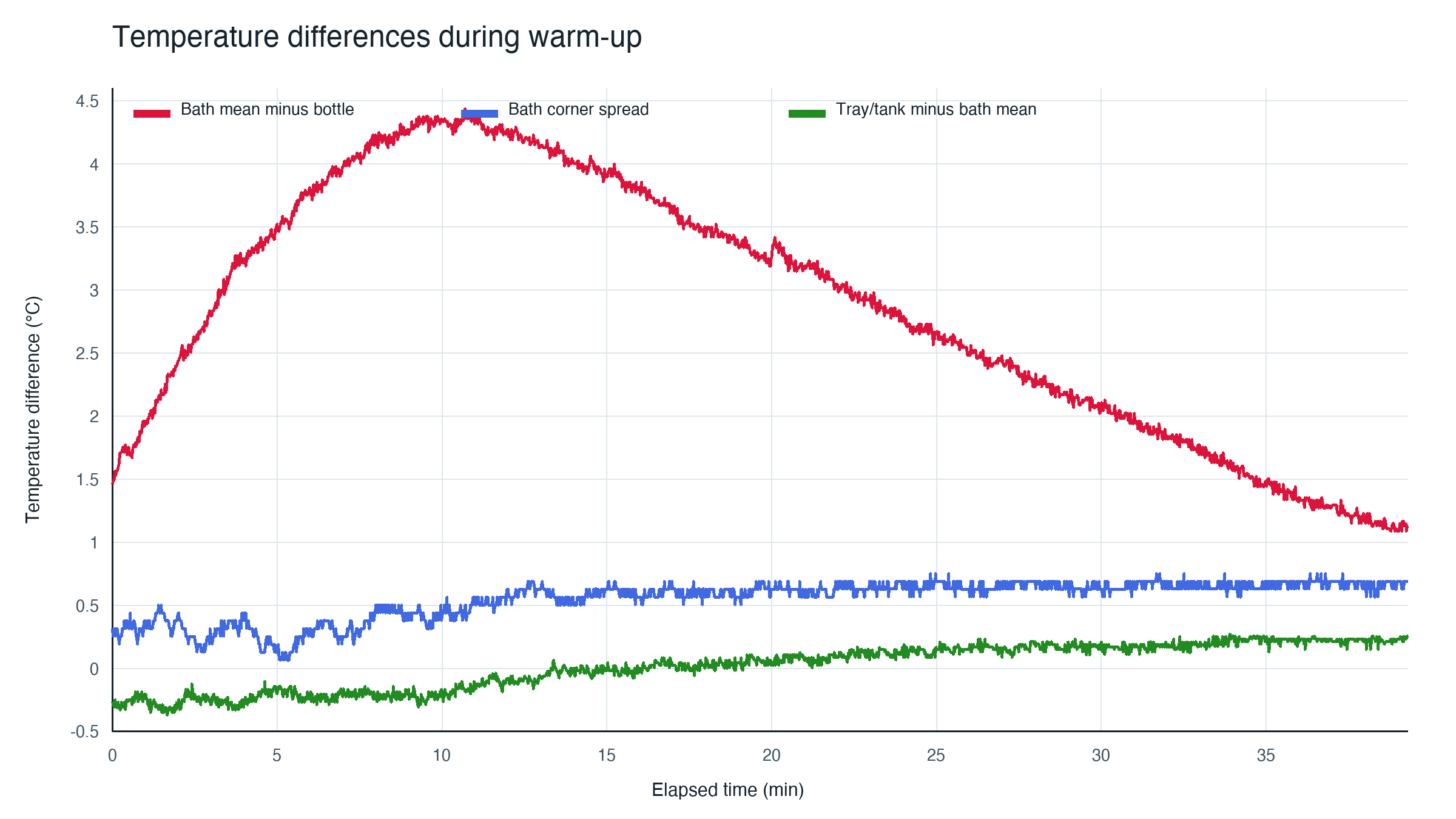 The recorded corner spread averaged approximately 0.66°C in the final two minutes. Both spatial differences and bottle deficit include any undocumented channel offsets.
The median interval was 1.002 s, but the mean sample-count rate was 0.894 Hz. There were 242 skipped sequence values and a largest timestamp interval of 2.226 s. Means weight recorded samples equally. These logs are useful time coverage, rather than an unbroken one-sample-per-second record.
Heating rate does not measure heater power
If the measured corner-mean slope represented uniform heating of exactly 8.0 kg of water, m × c_p × dT/dt would give approximately 363 W of water heat-storage rate; at 7.0 kg it would give 317 W. Exact mass, whole-bath temperature, room losses, pump heat, and enclosure heat capacity were not measured. These are conditional calculations, not heater input or efficiency measurements.
The previous 435 W figure comes from adding an assumed 20% allowance to the 8 kg calculation. That allowance has not been validated. The manual’s 800 W processor rating and the transcript’s unconfirmed “220 W” heater description also cannot identify this element’s rating. A readable label, isolated resistance measurement, and actual voltage/current are needed.
What the original machine manual establishes
The original CP-lift Instruction Manual has English technical sections, an unstated revision, and PDF page numbers one higher than its printed numbering:
- PDF page 2 (printed 1): approximately 7 L capacity, 800 W rated processor power, and manufacturer claims of PID control and ±0.1°C precision. These are machine specifications and claims, not measurements from this test.
- PDF pages 10–11 (printed 9–10): monitor chemistry temperature and rotate the tank during preheat; a bath-to-chemistry offset is expected.
- PDF page 14 (printed 13): at least five minutes of tank preheat and suggested 0.5–1°C bath compensation. The correct compensation must be tested at the intended loading and water level.
The manual describes the inline RCD as protection against dry heating. That wording does not document an independent temperature or low-water cutoff. Heater protection remains a hardware-verification task in the continued teardown.
Conclusions
The processor is a useful development platform. The drive problem appears concentrated in the exposed gear train and gearbox, while the motor still attempts to turn. The working thermal hardware provides a baseline to characterize once the required electrical checks are complete. The warm-up record adds a separate requirement: readiness has to follow the process container’s temperature, not merely a bath reading.
No repair or safety validation happened in this session — the machine is still an experimental unit pending disassembly, electrical checks, and full characterization.
Requirements this feeds into PanterLA
- Support established JOBO-style drums, with supported sizes defined mechanically.
- Keep the motor and gearbox away from bath water, or design an enclosure and shaft interface for that exposure specifically.
- Make the entire drive module removable and replaceable, with documented parts.
- Measure drum speed under load; support repeatable reversal/rotation modes.
- Circulate the bath well enough to minimize gradients, then verify it with logged measurements — not by assumption.
- Provide bottle holders as replaceable modules with a compatibility list.
- Use corrosion-resistant fasteners and appropriate printed materials near warm water and chemistry.
- Provide safe cable length, strain relief, protective earth, and verified leakage protection.
- Keep pumps, sensors, heaters, and control electronics accessible for inspection and replacement.
- Control the actual process temperature, not just a bath-referenced display value — a fixed
CA-style offset doesn’t track a bath-to-chemistry gap that can itself change during the process. - Publish CAD, wiring, component specifications, firmware, and every experiment record — including this one.
Next experiment
- Clean and photograph the machine before and during disassembly.
- Identify the motor, gearbox, pump, heater, probe, protection device, and electronics individually.
- Open the gearbox and document whether the failure is corrosion, stripped teeth, bearing seizure, or a combination.
- Check electrical safety before any further extended powered tests.
- Measure pump flow and drum speed under load.
- Build a compatibility table for drums and bottles.
- Define a protected replacement drive and a simpler, serviceable lift/clamp assembly.
Manual and reference documentation
The translated manual belongs to the WH1435+ family. Its menu descriptions do not establish exact WH1435A firmware behavior. The installed rear label is the source for the A-variant identification; original manufacturer documents take precedence over the project translation.
- Temperature experiment data and verification bundle — six raw CSV files across the three reviewed experiments, saved numerical summaries, and a Python standard-library verifier.
- Follow-up stability and teardown — a separate log after the channel corrections changed.
- JOBO CPE2 warm-up and solution transfer — a second processor used as a design reference.
- Choosing the replacement drum drive — the proposed motion architecture and loaded test.
Evidence and limitations
The raw CSVs are the source for numerical results; the video and photographs document setup and physical condition. Automatic captions contain recognition errors. No film or chemistry was processed. Inter-channel offsets were not documented for this warm-up, and room temperature, exact water mass, heater output, and controller state were not logged. The sensor alignment described in the next article occurred later and cannot be applied retrospectively to this dataset. The 1 October review independently reproduced the saved numerical metrics; it did not establish sensor accuracy or complete a safety validation.
Support the project
This THD Lift teardown-and-rebuild is being run as an open-source track within PanterLA, funded by the NordicLab community — parts, tools, and the time to make it a proper priority.
If you’d like to help push this one through, you can support the project goal on Ko-fi. Anything raised beyond the goal goes straight into further experiments, better components, and more of this kind of documentation.
Follow the rest of the series on YouTube and Instagram.
See you under the safe light.