A development update on bath circulation, bottle warm-up, and reheating a bottle in an already warm processor.
On 8 November, I tested the temperature behaviour of Panterla 0.1 with a simple practical goal: find out how long the bottles take to reach 38 °C, and whether adding a ROTEK circulation pump helps the bottles farther from the heater.
The clearest result was at the farthest bottle. Its fitted heating rate increased from 0.642 to 0.853 °C per minute with ROTEK, a 32.8% increase over the measured 28–35 °C interval. At about 30 minutes, the temperature difference between the warmest and coolest bottle readings was 1.875 °C before ROTEK and 0.688 °C with it.
That is encouraging evidence of better heat distribution in this setup. It also leaves an important piece unfinished: the farthest bottle did not reach 38 °C during either initial recording. These tests show progress, but they do not yet establish how long the complete set of bottles needs before processing can begin.
Watch the assembly and temperature tests
The video follows the bottle-frame assembly, the fit inside the bath, and the three temperature observations discussed below.
Watch on YouTube · Bath layout at 11:41 · Additional pump at 13:23 · Temperature results at 15:35
The bottle arrangement behind the curves
The prototype uses a Euro box with printed PETG bottle holders. I chose the box height so the JOBO bottles sit below the rim, leaving room to close the top. The holders retain the bottles by their projecting lip: an empty bottle needs to stay down in the water rather than float upward after its contents have been poured into the drum.
At the beginning of the video I explore an eight-bottle arrangement. The heating-test layout shown later has six bottles and the immersion circulator in a corner. The logger has five channels, so these measurements cover the bath and four instrumented bottles, rather than the temperature of every bottle in that layout. The four bottle numbers below identify the measured positions in increasing distance from the heater.
The holders are separate printed modules. In the assembly trial, I join them with short pieces of filament whose ends are melted into retaining heads. The heads can be cut off to separate the parts again. This makes the layout easier to revise than a permanently glued assembly. The hand-assembled joint felt rigid in the demonstration; long-term strength in the warm bath was not established by that trial.
The fit is deliberately compact. Paired bottles share an opening without a full divider, preserving space for a JOBO 1500-series drum alongside them. The video checks the drum’s fit, while its supports and drive remain work to complete. The holders are temporarily positioned with double-sided tape during this development stage, before committing to the final bath mounting.
That geometry also creates the thermal question. Water needs a route around the bottles and through the crowded parts of the bath. The first heating run uses the immersion circulator on its own; the second adds the 24 V ROTEK mixing pump used in the earlier CPE2 work. “Before ROTEK” therefore means before the auxiliary pump was added, with the immersion circulator already operating.
The empty-bottle check exposes a mechanical improvement too: the retaining lip holds the bottle down, but additional stops or small separators are needed to limit tilting. Lowering or revising the holder geometry is part of the next iteration. Retention, clearance for the drum, and room for water flow have to work together.
What I measured
I used five temperature channels: one in the water bath and one in each of four bottles. The bottles are numbered in order of increasing distance from the heater.
| Channel | Measurement position |
|---|---|
| S1 | Water bath |
| S2 | Bottle 1, nearest the heater |
| S3 | Bottle 2 |
| S4 | Bottle 3 |
| S5 | Bottle 4, farthest from the heater |
There are three separate observations in this update: an initial warm-up before the ROTEK run, a warm-up with the pump mixing the bath, and a later reheating test using only the probe in Bottle 1. The reheating test is a different operating situation: the bottle begins cool while the bath is already warm.
The 38 °C line is the target chosen for these tests. It is not a recorded controller setting or a universal processing recommendation. All times below start at the first recorded sample of the relevant test.
Before ROTEK: the bath gets there first
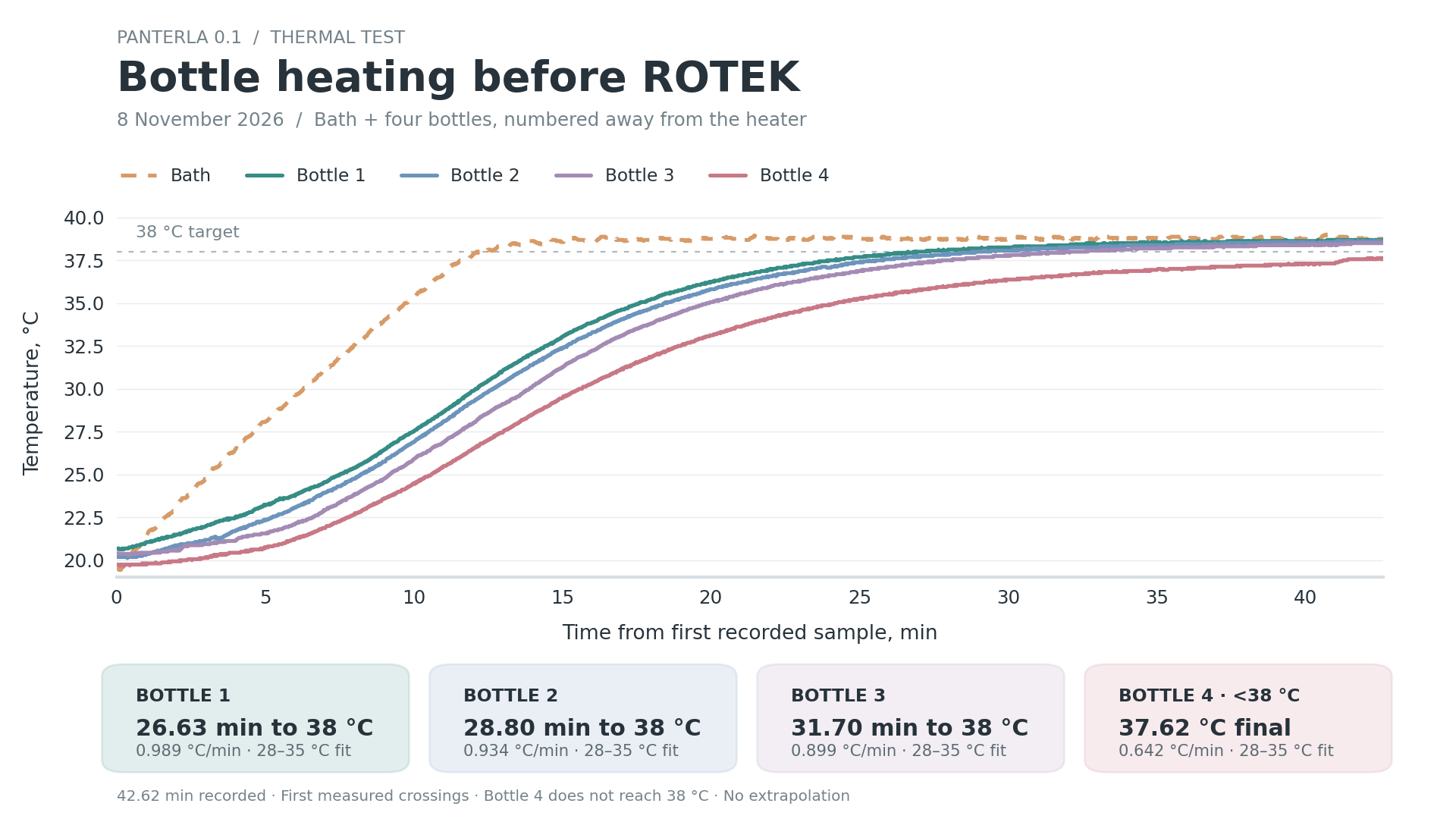
Figure 1. Initial warm-up before ROTEK. The dashed orange line is the bath; the four solid lines are the bottles. The horizontal reference marks 38 °C. The entire 42.62-minute recording is shown.
The initial readings were close to room temperature: 19.438 °C in the bath and 19.750–20.688 °C in the bottles. The bath first reached 38 °C after 12.11 minutes, but the nearest bottle needed 26.63 minutes. Bottle 2 followed at 28.80 minutes, and Bottle 3 at 31.70 minutes.
Bottle 4 was still at 37.625 °C when the recording ended after 42.62 minutes. Its curve was still approaching the target, so extending a straight line through the earlier ramp would give a misleading prediction of its remaining warm-up time.
This is the first useful lesson for Panterla: a bath reading at the target does not establish that the bottles are ready. In this run, the bath crossed 38 °C more than fourteen minutes before even the nearest bottle.
With ROTEK: the distant bottle benefits most
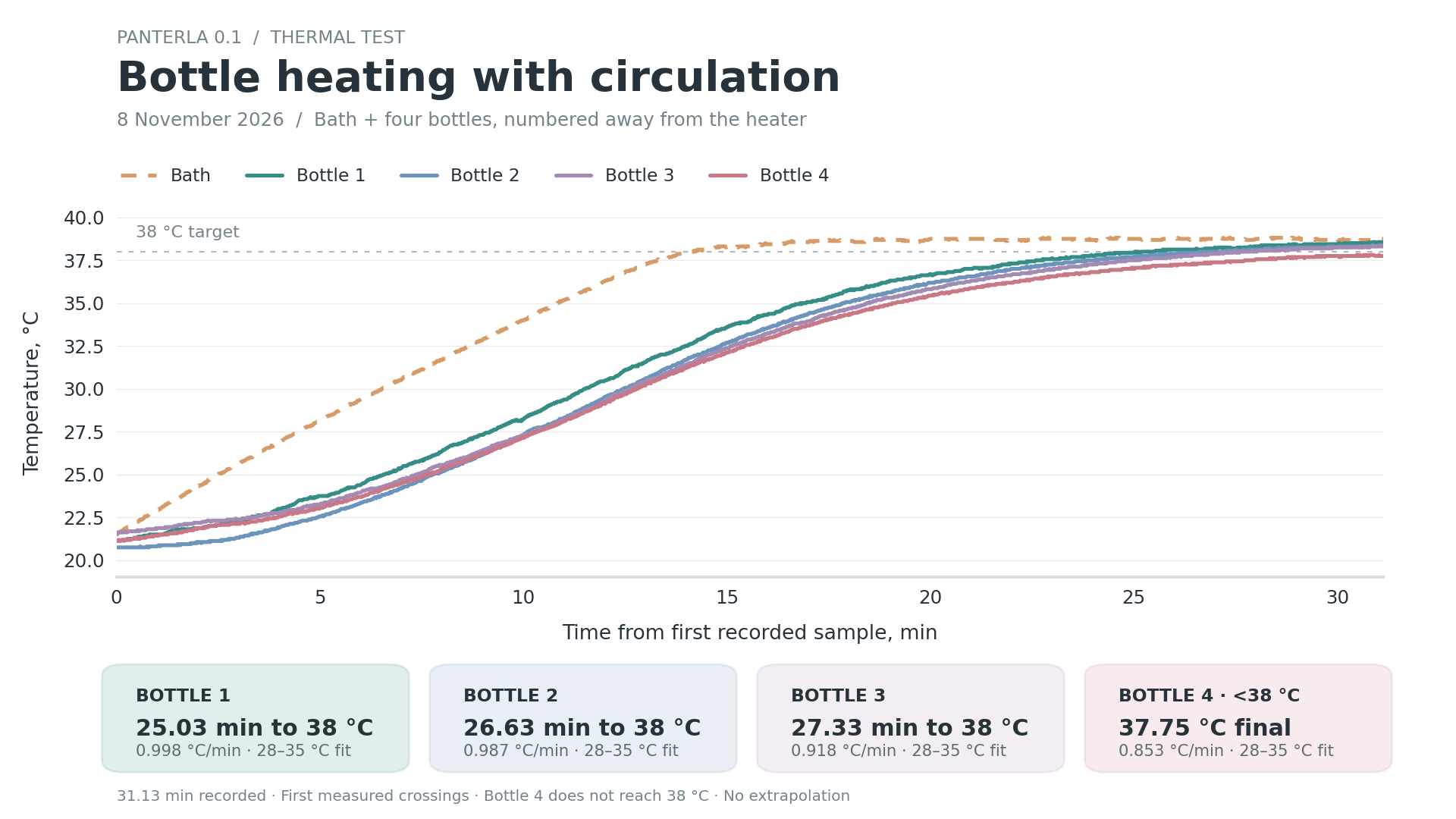
Figure 2. Warm-up with ROTEK mixing the bath. The sensor mapping and colours are unchanged. This recording ends at 31.13 minutes, earlier than the first run.
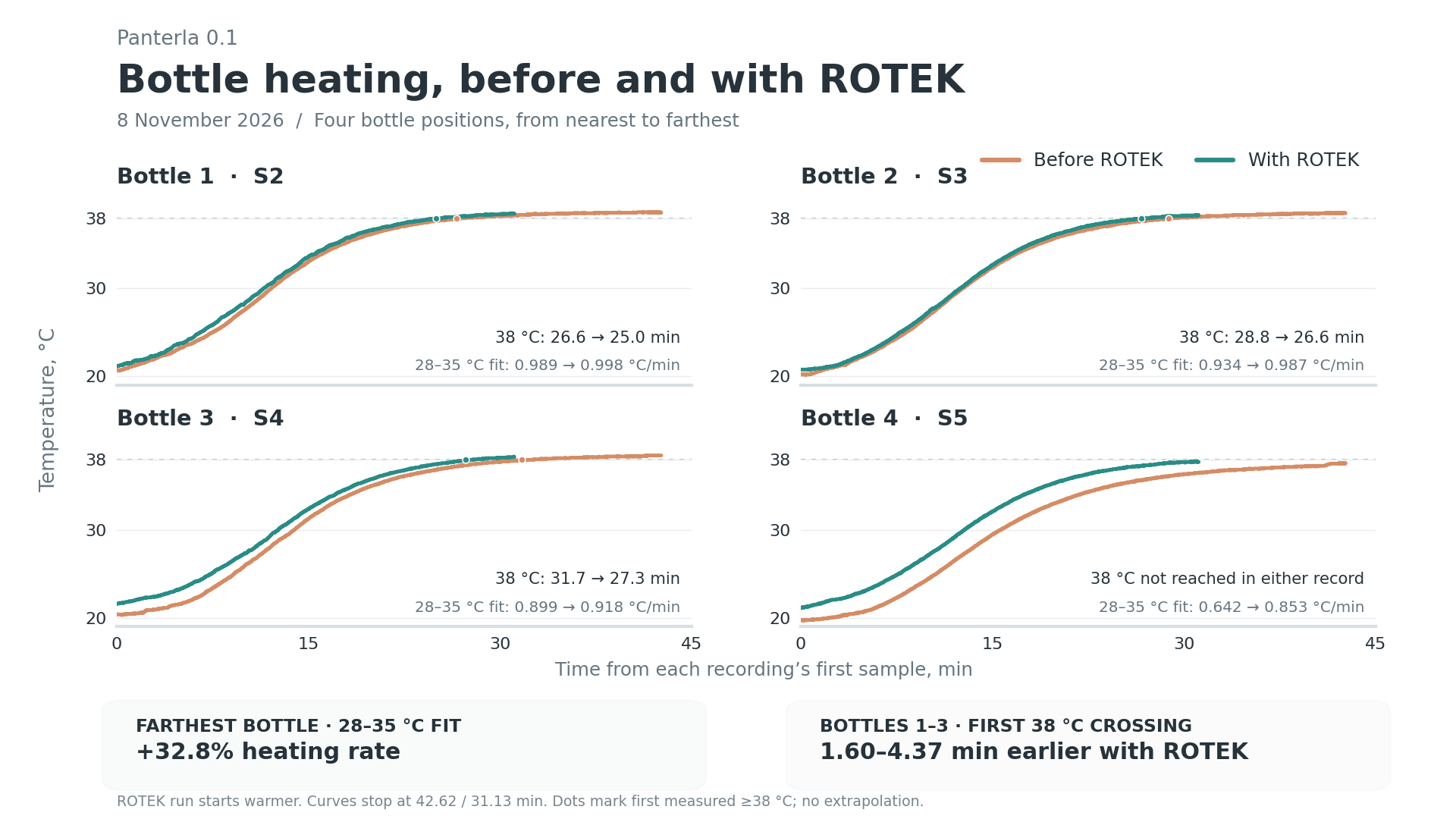
With the ROTEK pump, the first three bottles reached 38 °C at 25.03, 26.63, and 27.33 minutes. Compared with the earlier run, those crossings occurred 1.60, 2.17, and 4.37 minutes sooner.
The difference was more pronounced away from the heater. To compare the middle of each ramp, I fitted a heating rate to each channel’s recorded temperatures between 28 and 35 °C. Using the same temperature interval avoids comparing a steep early section in one run with a nearly settled section in another.
| Bottle | Before ROTEK | With ROTEK | Change in fitted rate |
|---|---|---|---|
| 1, nearest | 0.989 °C/min | 0.998 °C/min | +0.9% |
| 2 | 0.934 °C/min | 0.987 °C/min | +5.6% |
| 3 | 0.899 °C/min | 0.918 °C/min | +2.2% |
| 4, farthest | 0.642 °C/min | 0.853 °C/min | +32.8% |
The nearest bottle changed very little by this measure. The farthest bottle showed a much larger increase. That pattern is consistent with circulation helping distribute heat to a position that was warming more slowly. In the video, I also identify Bottle 4 as being made from a different material. Its slower curve therefore cannot be attributed to distance alone; this is a comparison of the assembled setup, rather than a controlled test of identical bottles at different positions.
The bath’s own fitted rate actually decreased, from 1.458 to 1.165 °C/min, and its first 38 °C reading arrived later: 14.11 minutes, versus 12.11 minutes before ROTEK. Meanwhile, the bottles reached the target earlier. A faster rise at the bath probe is therefore not the only useful measure of this system’s performance.
Comparing the bottles directly

Figure 3. One panel per bottle, with identical time and temperature scales. Orange is before ROTEK; teal is with ROTEK. Dots mark the first measured readings at or above 38 °C. Each curve ends where its recording ends.
The four-panel comparison makes the positional difference easier to see. The nearest bottle’s curves are close together. The farthest bottle’s curves separate much more clearly.
At the recorded samples nearest 30 minutes, the warmest and coolest bottle readings were 1.875 °C apart before ROTEK, compared with 0.688 °C with ROTEK. These values compare the same elapsed stage of the two recordings. They are more informative than comparing their final readings, because the runs have different lengths.
| Bottle | First measured 38 °C before ROTEK | First measured 38 °C with ROTEK |
|---|---|---|
| 1 | 26.63 min | 25.03 min |
| 2 | 28.80 min | 26.63 min |
| 3 | 31.70 min | 27.33 min |
| 4 | Not reached in 42.62 min | Not reached in 31.13 min |
Bottle 4 ended the ROTEK recording at 37.750 °C, with a recorded maximum of 37.812 °C. That is closer to the target than its earlier final reading, despite a shorter observation window, but it still does not establish a time when all four bottles are ready together.
Reheating a bottle in an already warm bath
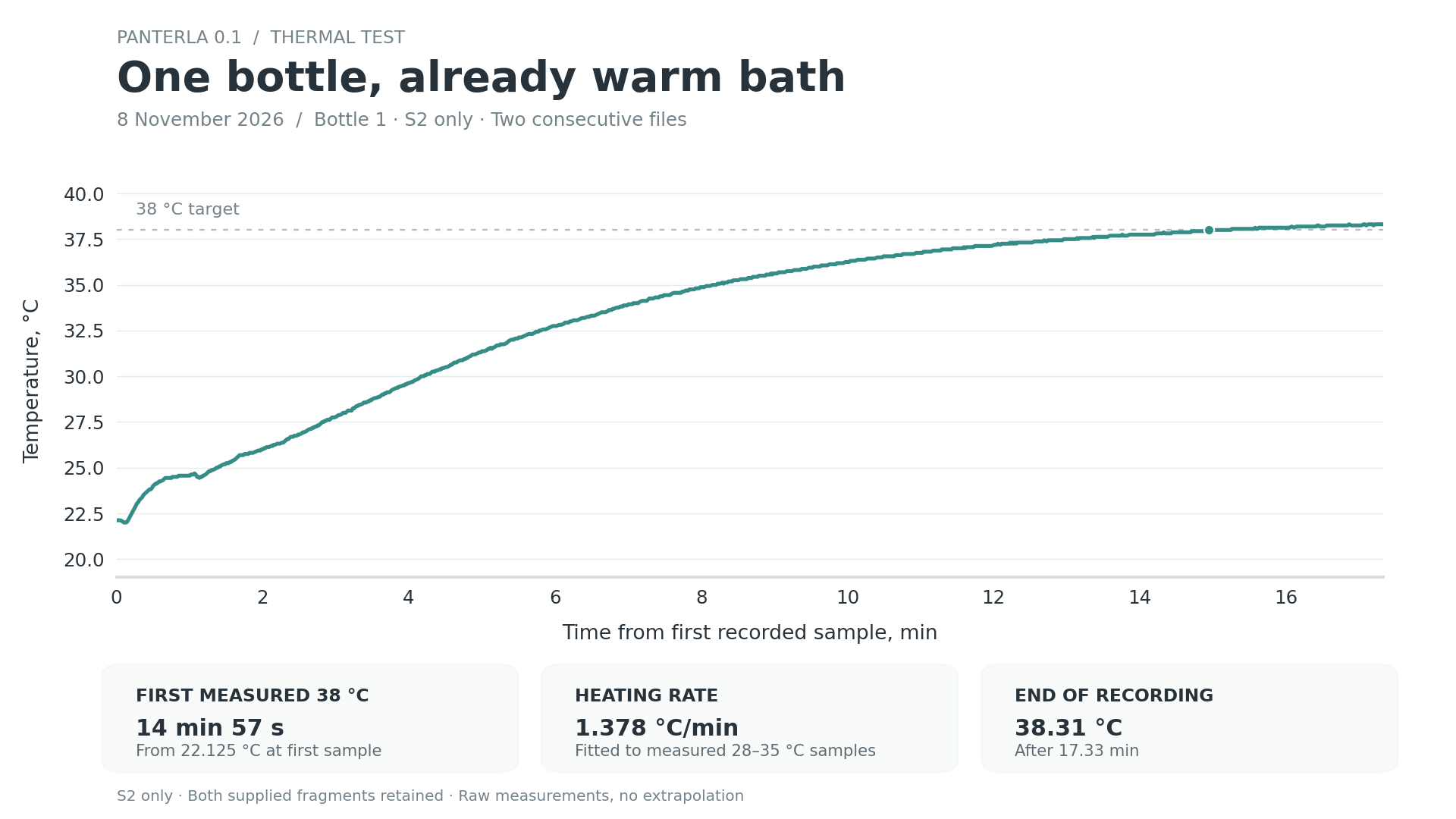
Figure 4. A separate reheating test using only S2, the Bottle 1 probe. Two consecutive logger files form the complete record. The other temperature channels are not included in this analysis.
The later bottle test began at 22.125 °C and first reached 38 °C after 14 minutes 57 seconds. The final reading was 38.312 °C after 17.33 minutes. Its fitted 28–35 °C heating rate was 1.378 °C/min.
For comparison, the same channel in the initial ROTEK warm-up began at 21.125 °C and reached 38 °C after 25.03 minutes. The reheating observation was therefore about 10.08 minutes shorter to the first target crossing.
The bath was already warm for the later test, so this is not another measurement of the pump’s effect. It answers a different practical question: how a cool bottle warms when the surrounding system is already at operating temperature.
This record also shows why the complete logging sequence matters. The first fragment covers the rise from 22.125 to 34.500 °C; the second begins 1.978 seconds later at 34.562 °C. Measuring only the second fragment would omit the first part of the warm-up. The 14-minute-57-second result uses both fragments, with a common elapsed-time origin.
How to read the results
The results support continuing the circulation approach. In these recordings, the farthest bottle warmed faster over the common fit interval, the spread between bottle readings was smaller at about 30 minutes, and the first three bottles crossed 38 °C earlier.
The video discusses the curves in approximate terms, including a roughly half-hour warm-up and an estimated bottle-recovery interval. The tables here use the archived recordings and the complete two-file reheating sequence. Neither the video nor these logs establishes a hold condition for all six bottles or a repeated film-processing cycle time.
There are limits to how precisely I can attribute those changes to the pump. The ROTEK run started warmer: its bottle readings were 0.437–1.375 °C higher than in the baseline. Bottle fill volumes, exact probe depths, ambient temperature, pump flow, heater output, and inter-probe calibration were not documented with the logs. The different material reported for Bottle 4 is another uncontrolled difference; its exact polymer and wall thickness were not recorded. There is one initial warm-up per configuration, rather than repeated matched trials. The percentage changes describe these measurements; they are not a guaranteed performance improvement for every load or setup.
Reaching 38 °C once also does not demonstrate temperature stability. Some readings briefly fell below the target again after their first crossing. A process-ready condition needs a defined acceptable temperature band and a hold interval, followed by a check that all required bottles satisfy it. These recordings do not yet provide that validation.
Conclusions for the next prototype
The useful performance measure is the temperature of the working liquids. The bath reaches the target well before the bottles, and its own ramp becomes slower in the ROTEK run even while the first three bottles reach 38 °C earlier. Optimizing the bath probe’s heating rate alone would miss that improvement. The +32.8% result belongs to Bottle 4’s fitted central ramp; it is not a 32.8% reduction in complete warm-up time, electrical consumption, or processing-cycle time.
Circulation is worth retaining and developing in this prototype. The smaller bottle-to-bottle spread at the same elapsed time and the stronger ramp at the limiting position support that decision. The next design question is how to deliver flow around the crowded holder geometry. The video proposes tubing from the pump outlet and, later, a heater arrangement that could replace the bulky immersion circulator. Their benefit has to be measured in another comparison. The present records do not establish a need for more heater power or identify heater power as the cause of the remaining lag.
Bottle retention and water circulation need to be designed together. The lip and filament-connected modules make the demonstrated arrangement practical to assemble and revise. The tilting observed with an empty bottle calls for better stops, while the temperature curves call for clear water paths. The next holder should improve both, with a warm-water loading test to check the joints and retention. A rigid-feeling dry assembly does not settle its long-term behaviour in service.
Initial warm-up and refill recovery need separate readiness rules. The measured 14 min 57 s reheating result is useful evidence for one cool bottle in an already warm system. It cannot be applied to every bottle position or multiplied into a laboratory throughput figure. The controller will eventually need to distinguish heating the whole machine, recovering after a refill, and holding the required liquids ready for a recipe. Readiness should depend on the required bottles remaining in a defined band for a defined interval, with current sensor data.
The next measurements that will resolve the open questions
- Separate position, bottle, and probe effects. Check probes together at a common temperature, document bottle materials and fill volumes, and repeat pump-on/pump-off runs from matched starting conditions. Move the slow bottle between positions while leaving probes fixed, then swap probes without changing the bottle arrangement. Those separate checks help distinguish the contributions.
- Finish the readiness observation. Continue past the slowest bottle’s target crossing and record the hold interval. Cover the two bottle positions not instrumented in this run before treating a six-bottle layout as characterized.
- Follow the liquid into the loaded drum. Repeat a defined preheat and pour with recorded bath level, rotation, liquid volume, and drum temperature. Bottle readiness is only one part of the eventual process; the earlier CPE2 transfer experiment shows why the receiving drum needs its own check.
- Repeat refill recovery. Test more than the nearest bottle, then repeated representative cycles. That will show whether recovery, holding, or another operation limits the actual machine’s cycle time.
These priorities give the control architecture a concrete requirement: report which part of the system is ready and what is still warming. A single bath-temperature indicator cannot yet answer that question for this prototype.
Thank you for following the development of Panterla. These measurements help turn a working prototype into a processor whose behaviour can be checked and understood. If you would like to support the next round of development and testing, you can find the project on Ko-fi.
Measurement note: heating rates are ordinary least-squares fits of temperature against elapsed time using each channel’s own measured 28–35 °C samples. Target times are the first recorded samples at or above 38 °C; no crossing times or future temperatures are extrapolated. Curves show recorded samples without smoothing. Reported precision does not establish calibrated absolute accuracy. The measurement bundle contains the raw recordings, processed tables, calculation summaries, analysis scripts, and experiment report.
Download and related experiments
The 8 November measurement bundle keeps the baseline, ROTEK warm-up, and complete two-file reheating record separate. Its manifest lists SHA-256 hashes for every included file. The archive preserves the project directory layout and includes reproduction commands in its README. The assembly and handling details added here come from the linked video and its supplied automatic subtitles; numerical tables and plots retain the archived measurement analysis.
For the earlier rotary-processor comparison, see JOBO CPE2 temperature and solution transfer and the CPE2 Rotek circulation-pump upgrade. Those measurements concern a different machine and probe layout. The control architecture explains where bottle readiness belongs in the proposed processor controls.