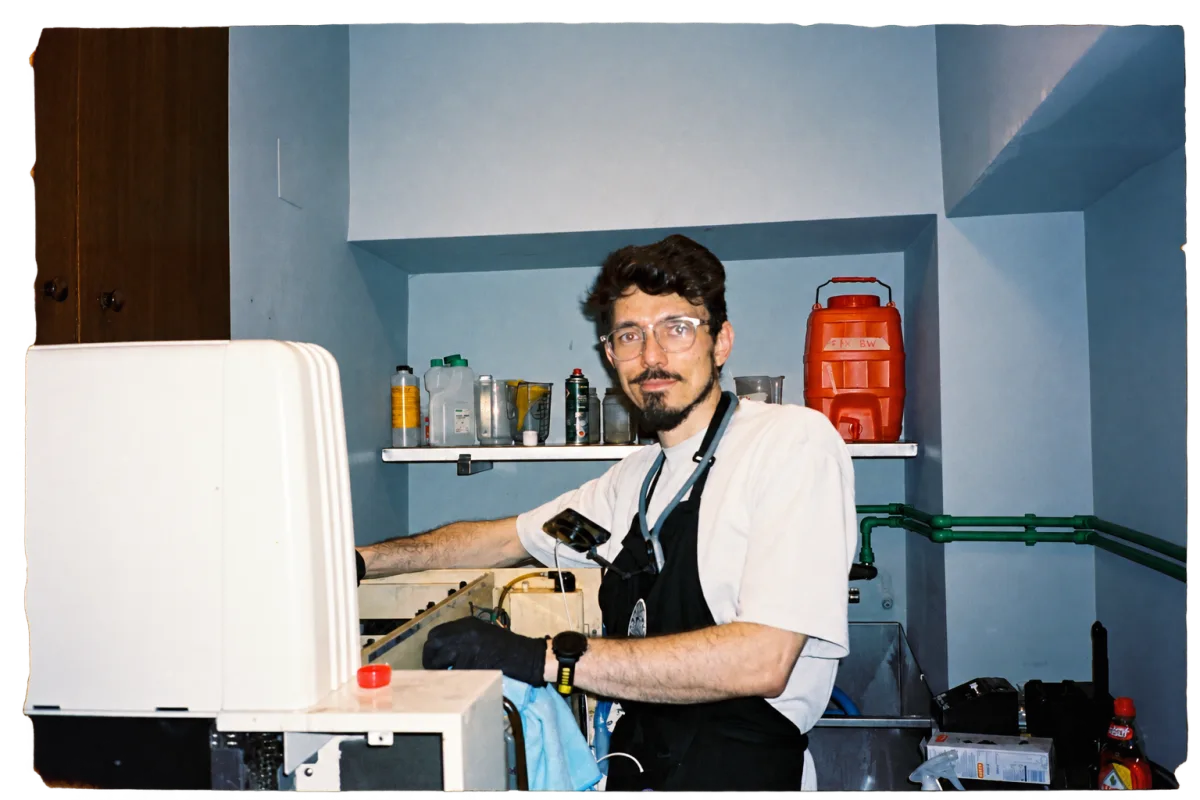
My name is Sasha Yakovlev. I am an engineer, maker, and film photographer, and the person behind NordicLab — an independent workshop focused on engineering for analog photography.
My professional background is in R&D, microfabrication, microelectronics, materials, manufacturing, and process development. For more than a decade I worked on everything from printed and flexible electronics to sensors, production equipment, automation, and bringing experimental technologies from prototypes into scalable manufacturing.
Today, however, most of my personal engineering work is focused on something much closer to me: film photography and the technology that keeps it alive.
NordicLab
NordicLab started with my own interest in film photography and darkroom printing, but over time it grew into something much larger.
I became increasingly interested not only in making photographs, but in everything that happens around them: developing film, controlling chemistry, printing in the darkroom, scanning, maintaining processors, repairing old laboratory machines, and understanding why these systems were designed the way they were.
At some point I realized that there is an enormous amount of engineering hidden behind analog photography.
And much of that engineering is slowly disappearing.
Many of the machines still used by photo labs today were designed twenty or thirty years ago. Manufacturers have stopped supporting a lot of them, spare parts are becoming difficult to find, service documentation disappears, and the people who originally knew how to repair these systems are gradually leaving the industry.
At the same time, film photography itself is very much alive.
That contradiction is one of the main reasons NordicLab exists.
Engineering for Film Photography
My work with NordicLab is about building, understanding, repairing, and documenting the tools used in analog photography.
Some projects are relatively small: darkroom accessories, safelights, film reels, loading tools, test-printing equipment, 3D-printable replacement parts, or improvements to existing systems.
Others are much more ambitious.
I am working on tools and systems for automated film development, precise temperature control, chemical handling and circulation, motor control, electronics, sensors, and new ways of building compact processing equipment for small labs and individual photographers.
Projects such as OpenReel and OpenTank are part of this approach: rather than treating existing photographic equipment as something fixed, I try to reconsider the problem from the beginning and design tools around the way we manufacture things today.
Modern CAD, 3D printing, affordable CNC manufacturing, microcontrollers, sensors, and small-scale electronics production give us possibilities that simply did not exist when much of the classic darkroom equipment was designed.
I want to use those possibilities without losing the knowledge accumulated by the photographic industry over the previous century.
Keeping Old Machines Alive
Another major part of NordicLab is repair and reverse engineering.
I spend time working hands-on in a photo lab, learning professional processing and scanning equipment from the inside. When something fails, I am usually more interested in understanding why it failed and how the whole system works than simply replacing a component.
That means tracing electronics, studying service manuals, measuring parts, rebuilding mechanisms, identifying sensors and motors, recreating discontinued components, and sometimes designing modern replacements for electronics that are no longer available.
I document as much of that work as possible.
The goal is not only to repair one machine.
If I spend several days understanding an undocumented mechanism or solving a problem in an old film processor, I want the next person facing the same problem to have somewhere to start.
This is why manuals, repair notes, CAD files, schematics, measurements, photographs, and detailed videos are such an important part of NordicLab.
Research, Not Just DIY
I also want NordicLab to go further than typical DIY photography projects.
When I investigate something like film scanning, darkroom illumination, chemical processing, temperature stability, or image quality, I try to approach it as an engineering problem: find the available research, measure what can be measured, understand the physical mechanisms involved, and separate assumptions from things we can actually demonstrate.
Analog photography contains a surprising amount of optics, chemistry, mechanics, electronics, control engineering, materials science, and manufacturing.
For me, that is part of what makes it so interesting.
The objective is not to make technology unnecessarily complicated. It is the opposite: understand the problem deeply enough to make the final tool simple, reliable, repairable, and useful.
Open Engineering
A very important part of NordicLab is sharing the work.
Whenever possible, I release designs, STEP files, documentation, experiments, repair information, and research so that other people can use them, modify them, or build upon them.
I strongly believe that this knowledge becomes much more valuable when it does not end with one project or one person.
Support from the NordicLab community helps me buy components, damaged machines, chemicals, materials, prototypes, measurement equipment, and the countless small parts required for this kind of work. In return, I try to make the results useful to as many people as possible.
A donation that helps repair one machine can eventually become a repair manual used by several laboratories.
Funding one prototype can result in an open design that hundreds of people can print.
Supporting one experiment can produce measurements and documentation available to everyone.
That is the model I want NordicLab to follow.
What I Want NordicLab to Become
I don’t see NordicLab simply as a YouTube channel or a small photography brand.
I want it to become an independent engineering workshop for analog photography.
A place where old photographic technology is documented and preserved.
A place where broken equipment is understood rather than discarded.
A place where new tools are designed for the realities of modern film photographers and small laboratories.
And a place where engineering knowledge is shared openly enough that other people can continue the work.
There is already an enormous amount of knowledge behind film photography. We do not need to reinvent all of it.
But we do need to preserve it, understand it, and start building on top of it again.
Film photography is still alive. Its engineering should be too.